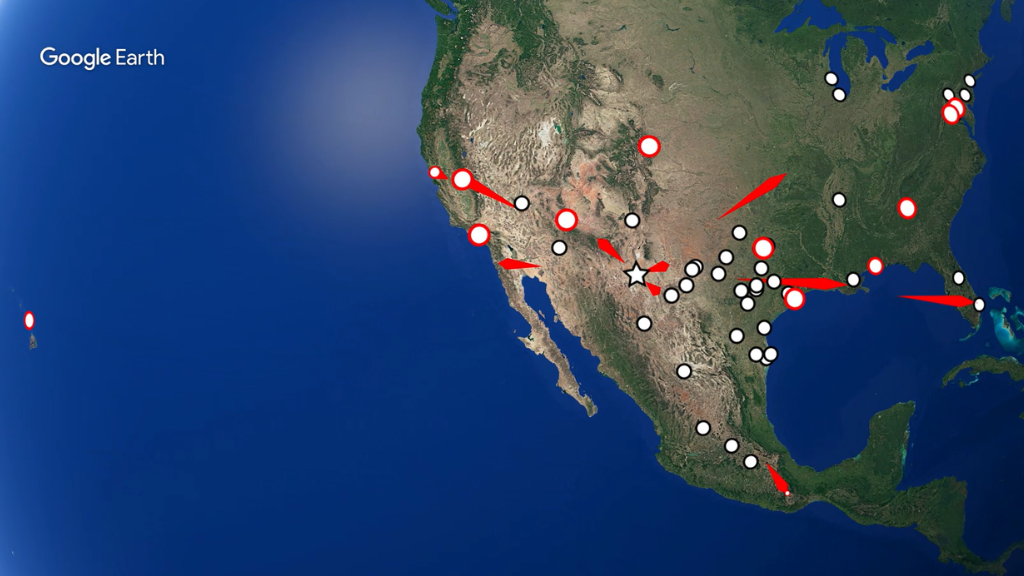
EL PASO, Texas (KVIA) -- This summer, El Paso County commissioners postponed two Commissioners Court meetings to attend educational sessions and policy meetings at a Louisiana conference -- part of a travel pattern that has cost taxpayers nearly a quarter-million dollars in recent years.
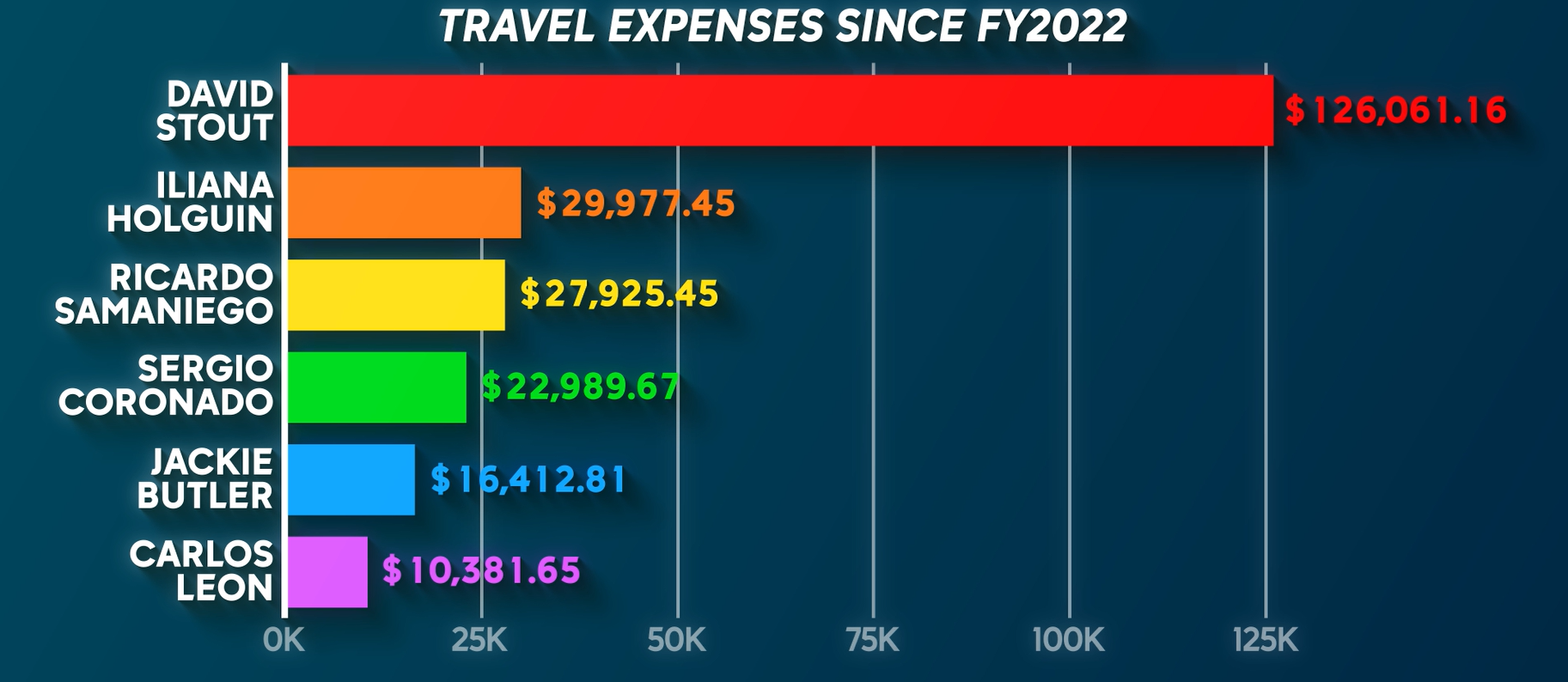
An ABC-7 analysis found county commissioners and the county judge spent nearly $234,000 on travel since fiscal year 2022. Of that amount, Commissioner David Stout accounted for more than $126,000, exceeding the combined travel spending of the county judge and all other commissioners.
ABC-7 obtained nearly five years of travel and expense records through an open records request under the Texas Public Information Act. The records span from fiscal year 2022 through May 2026. El Paso County's fiscal year runs from Oct. 1 through Sept. 30.
The records show commissioners frequently traveled to Washington, D.C.; Denver; Las Vegas; and, most often, Austin.
Some trips went much farther. In May, Stout traveled to Hawaii for a conference, and last year, County Judge Ricardo Samaniego traveled to Taiwan as part of a six-day economic development trip.
Stout's travel spending
Expense records from the County Auditor's Office analyzed by ABC-7 show that from fiscal year 2022 through May 2026, David Stout spent more than $126,000 on travel, more than four times the amount spent by the next-highest spender on the court.
Commissioner Iliana Holguin spent nearly $30,000 during the same period. Judge Ricardo Samaniego spent about $28,000. Commissioner Sergio Coronado spent almost $23,000.
The newest member of the court, Commissioner Jackie Butler, has spent more than $16,412 since taking office 20 months ago. Her predecessor, Carlos Leon, spent about $10,381 during his final 39 months in office.
The figure above shows the total travel expenses for each El Paso County commissioner and County Judge Ricardo Samaniego since fiscal year 2022. (Courtesy: KVIA)
Stout's annual travel spending peaked in fiscal year 2024 at $37,725, up from $29,701 in fiscal year 2023 and $13,425 in fiscal year 2022.
Records show he made nine trips to Austin that year, including testifying during a special legislative session, attending a Border Network for Human Rights rally and participating in Texas Conference of Urban Counties policy committee meetings.
In an interview with ABC-7, Stout defended the spending, arguing that such travel helps county officials advocate for El Paso and bring back ideas from other jurisdictions.
"I think it's very important to make sure that we have a seat at the table as often as possible," Stout said. "Again, we are in far West Texas. Austin forgets about us often. We are far away from Washington, D.C. If we are not there talking about what we need, there's really nobody talking about what counties need if we aren't in the space, if we're not sitting at the table."
Some of Stout's most expensive trips occurred during fiscal year 2024. The costliest was a May 2024 trip to Yosemite for the National Association of Counties' Western Interstate Region Conference. Records show Stout departed two days before the start of the conference on May 5 and returned May 10. The trip cost taxpayers about $3,559.
"So for example, I learned about doing energy audits at a conference that I went to. Brought that back home, talked to the commissioner's court. We had an energy audit done and are now working with Schneider Electric to basically invest in energy-saving infrastructure within our buildings that will save county taxpayers $40 million over the next 20 years."
- Stout
The following month, taxpayers funded a trip to Las Vegas for Stout to attend the National Association of Latino Elected and Appointed Officials conference at the Bellagio Hotel. Expense records show the trip cost more than $3,250.
Through May of this year, records show Stout spent more than $18,000 on travel. That includes a four-day National Association of Counties Western Interstate Region conference in Maui, Hawaii, in May.
A county travel expense form shows the trip cost taxpayers about $4,800.
Records show David Stout left El Paso on May 1, four days before the conference began, and returned May 10, two days after it ended.
Travel forms show taxpayers paid for his stay at the Hyatt Regency Maui Resort and Spa from May 3 through May 8. Conference records show preconference events began May 3, while the conference officially opened May 5 with an optional mobile tour of Haleakalā National Park.
"To save the county on costs, the only hotel nights paid for by the county were those of the WIR conference," Stout wrote in response to ABC-7's questions about the Hawaii trip.
Records also show Stout earned 7,024 Southwest Airlines Rapid Rewards points from the taxpayer-funded round-trip flight between El Paso and Maui.
"The travel being scrutinized represents a small fraction, approximately 0.02% of a nearly $500 million County budget."
- Stout
Records indicate Stout was accompanied by at least one county staff member on the Hawaii trip.
Stout said he often brings staff on larger conferences and advocacy trips, particularly when simultaneous sessions require additional coverage or when staff can help coordinate meetings with agency officials and congressional offices.
When asked whether family members, friends or other non-county personnel had accompanied him on taxpayer-funded trips, Stout said they had, but added he personally covered their expenses.
Stout also said traveling with a significant other is "not uncommon" among commissioners. When asked about taxpayers paying for a hotel room that could also accommodate a guest, Stout said the cost would be the same regardless of whether someone accompanied him.
"The hotel room is going to cost the same whether you have one or two people staying in the room," he said.
Samaniego's Taiwan trip and reimbursement
In fiscal year 2025, the largest single trip expense belonged to Samaniego.
Records show his March 2025 trip to Taiwan to attend the Smart City Summit & Expo initially cost taxpayers about $9,200, including roughly $7,855 in business-class airfare.
According to the Smart City Summit & Expo website, the annual conference in Taiwan brings together government officials, business leaders and technology companies to discuss smart-city development, infrastructure, sustainability and economic growth.
Before the trip, commissioners debated whether outside donations could help cover some of the costs. During a March 10, 2025, meeting, Commissioners Court voted unanimously to allow Samaniego to accept donations to help cover the cost of the six-day trip.
A week later, on March 17, while Samaniego was in Taiwan, Commissioners Court revisited the issue at his urging and reversed its earlier decision in a 4-0 vote, according to records reviewed by ABC-7.
During that meeting, County Chief Administrator Betsy Keller said Samaniego "ended up paying himself and did not accept donations for his travel," referring to any expenses above the normal tab covered by the county.
To determine how much taxpayers spent on the Taiwan trip, ABC-7 filed an open records request with the county on Aug. 24 seeking records detailing the travel expenses.
A receipt shows Samaniego reimbursed the county $4,024 on Sept. 2, 2026, one week after ABC-7 submitted a public records request for the travel records and more than a year after he filed a disclosure reporting $2,000 in outside funding for the trip.
Samaniego said the county initially reimbursed the full airfare for the Taiwan trip. However, as the auditor’s office prepared records for release to ABC-7, staff identified what they described as an error because county policy covers only economy-class travel. As a result, he said he reimbursed the county $4,200, representing the difference between the economy fare and the higher-priced business-class ticket he used.
Samaniego said the $2,000 donation was from the Taiwanese Council. ABC-7 found no record of the County Court voting again to allow donations to offset travel.
When asked about the use of business-class tickets, Samaniego said, "You don't want an elected official spending 19 hours sitting up and not being able to relax, not being able to read your material properly and getting ready for the trip, for the business experience."
County Judge Ricardo Samaniego said the trip helped pave the way for Wiwynn's expansion in Socorro. The company said it has invested more than $1.6 billion in its El Paso-area operations and expects to create nearly 1,000 jobs through 2027, with employment ultimately reaching 4,000 workers when the facility reaches full capacity.
"It cost, let's say, the $10,000. We now have 2,000 jobs," Samaniego said.
After receiving the records, ABC-7 followed up with Samaniego regarding the $2,000 donation, asking whether the money was paid directly to him and whether the donation had been approved by the court.
Mariana Barraza-Mitchell, senior policy advisory in the judge's office, said his office is reviewing the matter.
So far, we have not heard back.
ABC-7 has also reached out to contacts listed online for the Smart City Summit & Expo for comment.
County officials said the Taiwan trip's net cost to taxpayers was about $5,200 after the reimbursement.
Policy changes: Blanket travel approval for defeated commissioners
In El Paso County, travel for official business and training is permitted under county policy. County records show about $6.3 million has been budgeted for travel and professional education since fiscal year 2022.
"We have a travel policy, and it applies to everyone in the county from a regular employee who's traveling to an elected official to a commissioner, and of course, the judge also," County Auditor Barbara Parker said.
Under Texas law, Commissioners Court has the authority to set travel expenses and other allowances for county officials and employees. State law also requires county commissioners to complete at least 16 hours of certified continuing education each year. First-year commissioners must complete the training in person. Afterward, commissioners may take courses online with court approval and carry over up to eight excess hours.
Parker said all county-funded travel must be reviewed by her office and approved by Commissioners Court before travel funds are issued. Travelers then have 10 days after returning to submit an expense voucher documenting what they spent.
"The only thing that we don't ask for receipts on is the per diem because we don't need your receipt for meals when we're paying for the per diem," Parker said.
When ABC-7 asked whether the county has a policy governing travel rewards earned on taxpayer-funded trips, Parker said El Paso County has no policy addressing travel rewards, airline miles or other loyalty benefits earned on county business.
The county's travel policy also states that officials who lose a primary election or are not seeking re-election must receive additional court approval before traveling on county business.
"If there was an elected official that did not go before Commissioners Court and they're in that situation, we would not process the travel. We would kick it back and tell them they need to go to Commissioners Court first," Parker said.
ABC-7 reviewed Commissioners Court agendas following the March 3 primary and found that on March 30, about four weeks after Commissioner David Stout lost his re-election, he sought authorization through the consent agenda for himself and his staff to continue county-funded travel through the end of his term. Commissioners approved the request, according to meeting records reviewed by ABC-7.
"I continue to be a commissioner until the end of the year. And the duties that are assigned to me do not end until Dec. 31," Stout told ABC-7 when asked about his request.
On June 29, Commissioner Sergio Coronado made a similar request and it was approved.
Records show neither resolution specified how much additional travel was anticipated, and both listed the projected fiscal impact as unknown or not provided.
Parker said she had not seen such broad approval for post-election travel until this year.
"I personally, I haven't seen a blanket approval until this year, but there have been individual instances that have gone to Commissioners Court to get approved," Parker said.
Former Commissioner Andrew Haggerty, who served on Commissioners Court from 2015-18, told ABC-7 he would have opposed the blanket travel approval granted to Stout and Coronado after they lost their primary races.
"That was a mistake by the court," Haggerty said. "The basic duty of a county commissioner is managing the budget, and giving two lame-duck commissioners carte blanche for the rest of the year doesn't feel like being a fiduciary of that budget."
Shelved accountability measure
Last March, while Ricardo Samaniego was in Taiwan, he proposed a policy that would have required members of Commissioners Court to submit a report within 30 days of returning from county-funded travel, according to county meeting records reviewed by ABC-7.
Records show the proposal was initially postponed and later brought back after Samaniego returned. He completed a report following his Taiwan trip but ultimately moved to delete the item, saying the county attorney needed to review several issues before it could be reconsidered.
Asked why the measure never returned to Commissioners Court, Samaniego told ABC-7 it was "such a great idea to make them accountable," but said it ultimately "fell through the cracks" amid staffing changes in his office.
Samaniego said requiring elected officials to report on county-funded travel could reduce the amount of travel.
"When I did it in Cementos de Chihuahua, we cut back about 30% of the travel because they knew it wasn't just going to go have fun and come back," Samaniego said. "It was going to be you go, but you come back and you report on what you're going to be doing."
Samaniego said he still supports the proposal and intends to bring it back.
"I'll make sure I get it back on the agenda," he said.
The discussion comes as questions remain about how the county approves travel that exceeds its annual spending limit.
The county's travel policy generally limits employees to $6,000 annually for county business travel; however, Chief Auditor Parker explained trips related to legislative priorities or when someone is on the board for a conference are exempt from the cap.
When ABC-7 asked for the list of exemptions, we were told there isn’t one.
ABC-7 asked County Judge Ricardo Samaniego whether the county should establish clearer criteria or limits for granting exemptions rather than leaving those decisions to the court's discretion.
"Given the amount of taxpayer-funded travel approved under exemptions, should the county establish clear criteria or limits for when exemptions can be granted rather than leaving those decisions to the court's discretion?" ABC-7 asked.
"Yeah, I do agree," Samaniego responded.
He said the court’s discussion highlighted shortcomings in the current system and that the county should do a better job documenting the purpose and outcomes of travel so officials can explain what taxpayers received in return.
Commissioner Jackie Butler also said she would support such a requirement.
"I think that that's perfectly reasonable. I certainly do my best to communicate what I've been bringing home from the travel that I've been part of," Butler said.
ABC-7 requested interviews with Commissioners Iliana Holguin and Sergio Coronado. Coronado's office said he would be unavailable for several weeks, while Holguin's office did not respond to requests for comment.
Judge Samaniego is running for reelection against Republican candidate Minerva Torres Shelton in the November general election.
The cf_use_ob cookie informs Cloudflare to fetch the requested resource from the Always Online cache on the designated port. Applicable values are: 0, 80, and 443. The cf_ob_info and cf_use_ob cookies are persistent cookies that expire after 30 seconds.
session
cf_chl_rc_m
These cookies are for internal use which allows Cloudflare to identify production issues on clients.
session
_cfuvid
The _cfuvid cookie is only set when a site uses this option in a Rate Limiting Rule, and is only used to allow the Cloudflare WAF to distinguish individual users who share the same IP address.
session
cf_clearance
Whether a CAPTCHA or Javascript challenge has been solved.
session
__cfseq
Sequence rules uses cookies to track the order of requests a user has made and the time between requests and makes them available via Cloudflare Rules. This allows you to write rules that match valid or invalid sequences. The specific cookies used to validate sequences are called sequence cookies.
session
cf_ob_info
The cf_ob_info cookie provides information on: The HTTP Status Code returned by the origin web server. The Ray ID of the original failed request. The data center serving the traffic
session
__cfruid
Used by the content network, Cloudflare, to identify trusted web traffic.
session
__cf_bm
Cloudflare's bot products identify and mitigate automated traffic to protect your site from bad bots. Cloudflare places the __cf_bm cookie on End User devices that access Customer sites that are protected by Bot Management or Bot Fight Mode. The __cf_bm cookie is necessary for the proper functioning of these bot solutions.
session
__cfwaitingroom
The __cfwaitingroom cookie is only used to track visitors that access a waiting room enabled host and path combination for a zone. Visitors using a browser that does not accept cookies cannot visit the host and path combination while the waiting room is active.
session
cf_chl_rc_i
These cookies are for internal use which allows Cloudflare to identify production issues on clients.
session
cf_chl_rc_ni
These cookies are for internal use which allows Cloudflare to identify production issues on clients.
session
__cflb
When enabling session affinity with Cloudflare Load Balancer, Cloudflare sets a __cflb cookie with a unique value on the first response to the requesting client. Cloudflare routes future requests to the same origin, optimizing network resource usage. In the event of a failover, Cloudflare sets a new __cflb cookie to direct future requests to the failover pool.
session
These cookies are needed for adding comments on this website.
Name
Description
Duration
comment_author
Used to track the user across multiple sessions.
Session
comment_author_email
Used to track the user across multiple sessions.
Session
comment_author_url
Used to track the user across multiple sessions.
Session
A powerful search engine that organizes and provides access to vast information on the internet.
Name
Description
Duration
OSID
This cookie is used to collect website statistics and track conversion rates and Google ad personalisation
6 months
__Host-3PLSID
Used to sign in with Google account.
1 year
DV
This cookies is used to collect website statistics and track conversion rates and Google ad personalisation
1 year
LSID
This cookie is used to collect website statistics and track conversion rates and Google ad personalisation
6 months
COMPASS
This cookie is used to collect website statistics and track conversion rates and Google ad personalisation
2 days
__Secure-OSID
This cookie is used to collect website statistics and track conversion rates and Google ad personalisation
6 months
G_AUTHUSER_H
Google Authentication
session
__Secure-ENID
Used by Google to prevent fraudulent login attempts. This also contains a Google user ID which can be used for statistics and marketing purposes following a successful login
11 Months
UULE
sends precise location information from your browser to Googles servers so that Google can show you results that are relevant to your location. The use of this cookie depends on your browser settings and whether you have chosen to have location turned on for your browser.
6 hours
_gcl_dc
Used by Google AdSense for experimenting with advertisement efficiency across websites using their services.
3 months
SEARCH_SAMESITE
SameSite prevents the browser from sending this cookie along with cross-site requests. The main goal is mitigate the risk of cross-origin information leakage. It also provides some protection against cross-site request forgery attacks.
session
GCLB
This cookie is used in context with load balancing - This optimizes the response rate between the visitor and the site, by distributing the traffic load on multiple network links or servers.
Session
__Host-GAPS
Used to sign in with Google account.
1 year
NID
This cookies is used to collect website statistics and track conversion rates and Google ad personalisation
1 year
LSOLH
This cookie is for authentication with your Google account
1 year
TAID
This cookie is used to link your activity across devices if you've previously signed in to your Google Account on another device. We do this to coordinate that the ads you see across devices and measure conversion events.
14 days
g_enabled_idps
Used for Google Single Sign On
1 year
FPGCLDC
Used to help advertisers determine how many times users who click on their ads end up taking an action on their site
90 days
_gcl_au
Used by Google AdSense for experimenting with advertisement efficiency across websites using their services.
3 months
_dcid
Collects information on user behaviour on multiple websites. This information is used in order to optimize the relevance of advertisement on the website.
400 days
CONSENT
Google cookie consent tracker
20 years
SAPISID
Download certain Google Tools and save certain preferences, for example the number of search results per page or activation of the SafeSearch Filter. Adjusts the ads that appear in Google Search.
2 years
SNID
This cookie is used to collect website statistics and track conversion rates and Google ad personalisation
6 months
AID
Download certain Google Tools and save certain preferences, for example the number of search results per page or activation of the SafeSearch Filter. Adjusts the ads that appear in Google Search.
1 year
FCCDCF
Cookie for Google Funding Choices API which allows for functionality specific to consent gathering for things like GDPR consent and CCPA opt-out.
13 months
SID
Download certain Google Tools and save certain preferences, for example the number of search results per page or activation of the SafeSearch Filter. Adjusts the ads that appear in Google Search.
2 years
FCNEC
Cookie for Google Funding Choices API which allows for functionality specific to consent gathering for things like GDPR consent and CCPA opt-out.
13 months
HSID
Download certain Google Tools and save certain preferences, for example the number of search results per page or activation of the SafeSearch Filter. Adjusts the ads that appear in Google Search.
2 years
receive-cookie-deprecation
This cookie ensures browers in an experiment group of the Chrome-facilitated testing period include the Sec-Cookie-Deprecation request header as soon as it becomes available.
180 days
APISID
Download certain Google Tools and save certain preferences, for example the number of search results per page or activation of the SafeSearch Filter. Adjusts the ads that appear in Google Search.
2 years
OTZ
Aggregate analysis of website visitors
17 days
GN_PREF
This cookie is used to collect website statistics and track conversion rates and Google ad personalisation
1 year
__Host-1PLSID
Used to sign in with Google account.
1 year
A
Google uses this cookies to make advertising more engaging to users and more valuable to publishers and advertisers
17 days
SIDCC
Download certain Google Tools and save certain preferences, for example the number of search results per page or activation of the SafeSearch Filter. Adjusts the ads that appear in Google Search.
2 years
SOCS
Stores a user's state regarding their cookies choices
13 months
SSID
Download certain Google Tools and save certain preferences, for example the number of search results per page or activation of the SafeSearch Filter. Adjusts the ads that appear in Google Search.
2 years
cookies_accepted
This functionality cookie is simply to verify that you have allowed us to set cookies on your machine
1 year
ACCOUNT_CHOOSER
Used to sign in with Google account.
session
1P_JAR
These cookies are set via embedded youtube-videos. They register anonymous statistical data on for example how many times the video is displayed and what settings are used for playback.
1 month
SMSV
Used to sign in with Google account.
session
gcl
Helps advertisers determine user actions on their site after clicking an ad
90 days
gac
Measure user activity and ad campaign performance for advertisers
90 days
AdID
Show Google ads on non-Google sites and personalize ads based on user settings
2 weeks
DSID
Identifies signed-in users on non-Google sites to respect ad personalization settings
2 weeks
_Secure-ENID
Remembers user preferences like language, search results per page, and SafeSearch settings
13 months
Secure-YEC
Serve a similar purpose for YouTube, including detecting and resolving problems
13 months
CGIC
Improves search results delivery by autocompleting queries based on user input
6 months
_Secure-YEC
Used to detect spam, fraud, and abuse to protect advertisers and YouTube creators
13 months
django_language
Cookie necessary for the use of the options and services of the website.
3 month
Google reCAPTCHA helps protect websites from spam and abuse by verifying user interactions through challenges.
Name
Description
Duration
_GRECAPTCHA
Google reCAPTCHA sets a necessary cookie (_GRECAPTCHA) when executed for the purpose of providing its risk analysis.
179 days
Google Tag Manager simplifies the management of marketing tags on your website without code changes.
Name
Description
Duration
cookiePreferences
Registers cookie preferences of a user
2 years
td
Registers statistical data on users' behaviour on the website. Used for internal analytics by the website operator.
session
Viafoura enhances audience engagement through real-time commenting and interactive features for digital publishers.
Name
Description
Duration
VfSess
This cookie is used to session identifier for authentication
30 days
VfRefresh
This cookie is used to refresh identifier for authentication
1 year
_vfa
This cookie is used to stores user and session identifiers for analytics.
1 year
_vfb
This cookie is used to stores recirculation data for analytics.
30 minutes
_vfz
This cookie is used to stores referral data for analytics
6 minutes
_vf_rd_test
This cookie is used to test best domain name (SLD+TLD) to set cookies at.
1 second
VfAccess
This cookie is used to access identifier for authentication
5 minutes
vfThirdpartyCookiesEnabled
This cookie is used to testing if 3rd party cookies are supported
Session
Vimeo is a video hosting platform for high-quality content, ideal for creators and businesses to showcase their work.
Registers a unique ID on mobile devices to enable tracking based on geographical GPS location.
1 day
VISITOR_INFO1_LIVE
Tries to estimate the users' bandwidth on pages with integrated YouTube videos. Also used for marketing
179 days
PREF
This cookie stores your preferences and other information, in particular preferred language, how many search results you wish to be shown on your page, and whether or not you wish to have Google’s SafeSearch filter turned on.
10 years from set/ update
YSC
Registers a unique ID to keep statistics of what videos from YouTube the user has seen.
Session
DEVICE_INFO
Used to detect if the visitor has accepted the marketing category in the cookie banner. This cookie is necessary for GDPR-compliance of the website.
179 days
VISITOR_PRIVACY_METADATA
Youtube visitor privacy metadata cookie
180 days
LOGIN_INFO
This cookie is used to play YouTube videos embedded on the website.
2 years
Statistics cookies collect information anonymously. This information helps us understand how visitors use our website.
Google Analytics is a powerful tool that tracks and analyzes website traffic for informed marketing decisions.
ID used to identify users for 24 hours after last activity
24 hours
_gat
Used to monitor number of Google Analytics server requests when using Google Tag Manager
1 minute
_gac_
Contains information related to marketing campaigns of the user. These are shared with Google AdWords / Google Ads when the Google Ads and Google Analytics accounts are linked together.
90 days
__utma
ID used to identify users and sessions
2 years after last activity
__utmt
Used to monitor number of Google Analytics server requests
10 minutes
__utmb
Used to distinguish new sessions and visits. This cookie is set when the GA.js javascript library is loaded and there is no existing __utmb cookie. The cookie is updated every time data is sent to the Google Analytics server.
30 minutes after last activity
__utmc
Used only with old Urchin versions of Google Analytics and not with GA.js. Was used to distinguish between new sessions and visits at the end of a session.
End of session (browser)
__utmz
Contains information about the traffic source or campaign that directed user to the website. The cookie is set when the GA.js javascript is loaded and updated when data is sent to the Google Anaytics server
6 months after last activity
__utmv
Contains custom information set by the web developer via the _setCustomVar method in Google Analytics. This cookie is updated every time new data is sent to the Google Analytics server.
2 years after last activity
__utmx
Used to determine whether a user is included in an A / B or Multivariate test.
18 months
_ga
ID used to identify users
2 years
_gali
Used by Google Analytics to determine which links on a page are being clicked
30 seconds
_ga_
ID used to identify users
2 years
Marketing cookies are used to follow visitors to websites. The intention is to show ads that are relevant and engaging to the individual user.
A comprehensive digital advertising platform for managing campaigns, optimizing performance, and analyzing audience data.
Name
Description
Duration
ar_debug
Store and track conversions
Persistent
test_cookie
This cookie is set by DoubleClick (which is owned by Google) to determine if the website visitor's browser supports cookies.
1 year
APC
This cookie is used for targeting, analyzing and optimisation of ad campaigns in DoubleClick/Google Marketing Suite
6 months
RUL
Used by DoubleClick to determine if the website ad was properly displayed. This is done to make their marketing efforts more efficient.
1 year
FLC
This cookie is used to link your activity across devices if you’ve previously signed in to your Google Account on another device. We do this to coordinate that the ads you see across devices and measure conversion events.
10 seconds
__gads
This cookie is used by Google for a variety of purposes (e.g., ensuring Frequency Caps work correctly). It includes AdSense if you have AdSense enabled. This cookie is associated with the DoubleClick for Publishers service from Google. Its purpose is to monitor the showing of advertisements on the site, for which the owner may earn some revenue. The main purpose of this cookie is targeting/advertising.
various
GoogleAdServingTest
Used to register what ads have been displayed to the user.
session
IDE
This cookie is used for targeting, analyzing and optimisation of ad campaigns in DoubleClick/Google Marketing Suite
2 years
DSID
This cookie is used for targeting, analyzing and optimisation of ad campaigns in DoubleClick/Google Marketing Suite
2 weeks
ID
This cookie is used for targeting, analyzing and optimisation of ad campaigns in DoubleClick/Google Marketing Suite
2 months
Google Ads is an online advertising platform that enables businesses to create targeted ads displayed on Google search results and partner sites.
Profiles the interests of website visitors to serve relevant and personalised ads through retargeting.
2 years
AEC
AEC cookies ensure that requests within a browsing session are made by the user, and not by other sites. These cookies prevent malicious sites from acting on behalf of a user without that user's knowledge.
6 months
__Secure-1PSID
Targeting cookie. Used to create a user profile and display relevant and personalised Google Ads to the user.
2 years
__Secure-1PAPISID
Targeting cookie. Used to create a user profile and display relevant and personalised Google Ads to the user.
2 years
__Secure-3PSID
Targeting cookie. Used to profile the interests of website visitors and display relevant and personalised Google ads.
2 years
_gcl_gs
Google uses cookies for advertising, including serving and rendering ads, personalizing ads (depending on your ad settings at g.co/adsettings), limiting the number of times an ad is shown to a user, muting ads you have chosen to stop seeing, and measuring the effectiveness of ads.
90 Days
__Secure-1PSIDCC
Targeting cookie. Used to create a user profile and display relevant and personalised Google Ads to the user.
2 years
_gcl_gb
Google uses cookies for advertising, including serving and rendering ads, personalizing ads (depending on your ad settings at g.co/adsettings), limiting the number of times an ad is shown to a user, muting ads you have chosen to stop seeing, and measuring the effectiveness of ads.
90 Days
_gac_gb_
Google uses cookies for advertising, including serving and rendering ads, personalizing ads (depending on your ad settings at g.co/adsettings), limiting the number of times an ad is shown to a user, muting ads you have chosen to stop seeing, and measuring the effectiveness of ads.
90 Days
FPGCLGB
Google uses cookies for advertising, including serving and rendering ads, personalizing ads (depending on your ad settings at g.co/adsettings), limiting the number of times an ad is shown to a user, muting ads you have chosen to stop seeing, and measuring the effectiveness of ads.
90 Days
Conversion
Google uses cookies for advertising, including serving and rendering ads, personalizing ads (depending on your ad settings at g.co/adsettings), limiting the number of times an ad is shown to a user, muting ads you have chosen to stop seeing, and measuring the effectiveness of ads.
90 days
ADS_VISITOR_ID
Cookie required to use the options and on-site web services
2 months
__Secure-3PSIDCC
Targeting cookie. Used to create a user profile and display relevant and personalised Google Ads to the user.
2 years
__Secure-3PSIDTS
Targeting cookie. Used to create a user profile and display relevant and personalised Google Ads to the user.
2 years
__Secure-1PSIDTS
Targeting cookie. Used to create a user profile and display relevant and personalised Google Ads to the user.
2 years
_gcl_aw
Google uses cookies for advertising, including serving and rendering ads, personalizing ads (depending on your ad settings at g.co/adsettings), limiting the number of times an ad is shown to a user, muting ads you have chosen to stop seeing, and measuring the effectiveness of ads.
90 Days
FPGCLAW
Google uses cookies for advertising, including serving and rendering ads, personalizing ads (depending on your ad settings at g.co/adsettings), limiting the number of times an ad is shown to a user, muting ads you have chosen to stop seeing, and measuring the effectiveness of ads.
90 Days
Monetize your website by displaying targeted ads and earning revenue from clicks and impressions.
Name
Description
Duration
__gsas
Provides ad delivery or retargeting.
3 months
__gpi
Collects information on user behaviour on multiple websites. This information is used in order to optimize the relevance of advertisement on the website.
13 months
__gpi_optout
Collects information on user behaviour on multiple websites. This information is used in order to optimize the relevance of advertisement on the website.
13 months
GED_PLAYLIST_ACTIVITY
Improves targeting/advertising within the website
session
ACLK_DATA
This cookie is used to help improve advertising. This targets advertising based on what's relevant to a user, to improve reporting on campaign performance.
5 minutes
ANID
Cookies used for functionality allow users to interact with a service or site to access features that are fundamental to that service. Things considered fundamental to the service include preferences like the user's choice of language, product optimizations that help maintain and improve a service, and maintaining information relating to a user's session, such as the content of a shopping cart.
13 months
__eoi
This cookie is used for security authenticate users, prevent fraud, and protect users as they interact with a service.
3 Months
pm_sess
This cookie is used for functionality allow users to interact with a service or site to access features that are fundamental to that service. Things considered fundamental to the service include preferences like the user's choice of language, product optimizations that help maintain and improve a service, and maintaining information relating to a user's session, such as the content of a shopping cart.
30 minutes
pm_sess_NNN
This cookie is used for functionality allow users to interact with a service or site to access features that are fundamental to that service. Things considered fundamental to the service include preferences like the user's choice of language, product optimizations that help maintain and improve a service, and maintaining information relating to a user's session, such as the content of a shopping cart.
30 minutes
aboutads_sessNNN
This cookie is used for security authenticate users, prevent fraud, and protect users as they interact with a service.
30 minutes
Nativo is a platform that connects brands with native advertising opportunities to enhance content marketing.
Name
Description
Duration
opt_out
This cookie is used to remember not to serve that user targeted Ads if they opt out.
1 year
visitor
This cookie is used to identify a unique visitor to the site.