Faith vs. Border Fence

Editor's Note: This article is co-published published by Puente News Collaborative, a bilingual nonprofit newsroom that covers stories from Mexico and the U.S.-Mexico border and KTEP public radio .
By Angela Kocherga
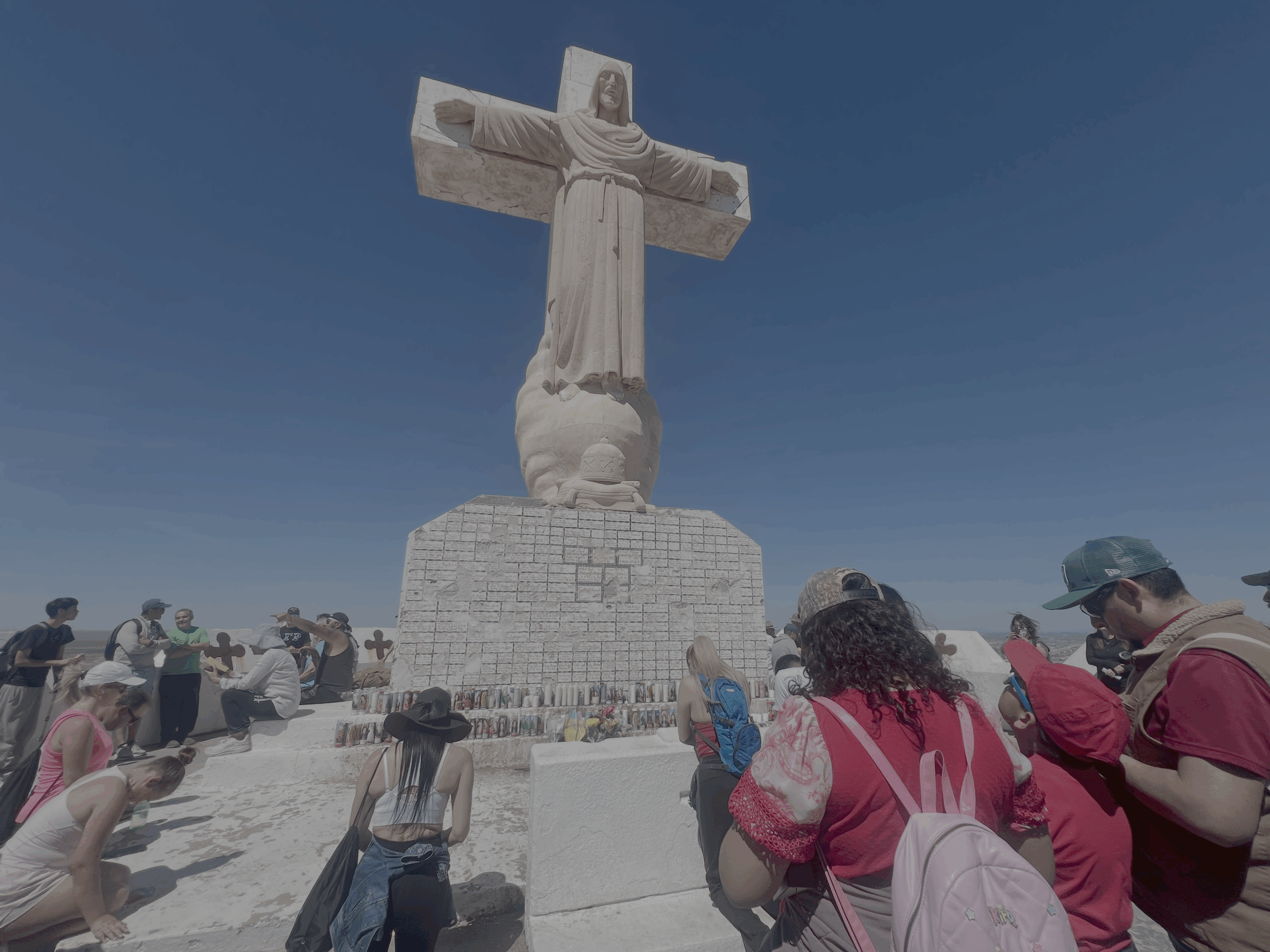
SUNLAND PARK, N.M. -- The gleaming white sculpture of Jesus Christ at the top of windswept Mount Cristo Rey towers over this tiny border town, yet it looms large in the region, seen from miles away in Texas, New Mexico and the Mexican state of Chihuahua.
The federal government, in an eminent domain lawsuit, and in its effort to “wall off” the entire United States from Mexico, is now determined to seize about 14 acres of land at the foot of the mountain facing its southern neighbor. A hearing on the Trump administration’s motion to take “immediate possession” of the land, owned by the Catholic Diocese of Las Cruces, New Mexico, is scheduled for July 23rd in federal court.
Long a symbol of faith and unity along this stretch of rugged borderland, Mount Cristo Rey is now at the center of a bitter legal battle over religious freedom and border security. The diocese calls the land a “holy site.”
For generations countless thousands of pilgrims have hiked up to the 29-foot limestone figure of Jesus with outstretched arms, anchoring a site considered holy by the diocese, which owns the property.
They’ve trekked to pray, tidy up the area, or simply take in the stunning view of the United States southern border and Mexico’s northern frontier. The faithful aren’t happy.
“STEALING THE LAND”
“I give thanks for all my blessings,” said Ramon Garcia, 73, who along with thousands makes the pilgrimage every Good Friday. He said there is no need for a wall, and admonished the Trump administration for “just stealing the land, land that belongs to us.”
The fight over building barriers in sensitive locations is happening all along the border in areas that include wildlife corridors and national park land in Texas, habitat for endangered cross border species like Jaguars and ancient tribal sites in Arizona and now in New Mexico.
The diocese turned down the Trump administration’s effort to pay $183,071.00 to take property. In its suit filed in May, the diocese said the government is violating the First Amendment’s Free Exercise Clause and the Religious Freedom Restoration Act.
"The United States government's effort to condemn diocesan land to build a border wall is an affront to religious liberty,” said attorney William Powell, senior counsel with the Institute for Constitutional Advocacy and Protection at Georgetown Law School in Washington, D.C. Powell described the government’s actions as “heavy-handed tactics.”
ILLEGAL CROSSINGS DECLINE DRAMATICALLY
In response, a Department of Homeland Security spokesperson said, “Access to the shrine will not be affected, as all attendees enter from the U.S. side.”
According to the DHS statement, “The only individuals who could POSSIBLY be impacted by the border wall are illegal aliens attempting to illegally enter our country.” The agency maintains that the mountain is a well-worn smuggling route.
In the lawsuit, the federal government said it needs the property “to construct, install, operate, and maintain roads, fencing, vehicle barriers, security lighting, cameras, sensors, and related structures designed to help secure the United States/Mexico border within the state of New Mexico.”
These days, Mount Cristo Rey is heavily guarded by the U.S. Border Patrol agents on horseback, helicopters, and by drones overhead. Ground sensors and cameras permeate the desert landscape.
Illegal crossings are down by more than 90 percent since the peak in 2023, according to the U.S. Customs and Border Protection.
This stretch of borderland has long been a backdrop for high-profile border wall projects since Trump supporters erected a half-mile steel barrier on private property in Sunland Park in 2019.
“We Build the Wall” organizers raised about $25 million in a crowdfunding campaign. The founder and two other organizers were later convicted or pleaded guilty to defrauding donors and pocketing hundreds of thousands of dollars after promising 100 percent of the money would go to build a wall on the border in New Mexico and Texas. Steve Bannon was also charged in connection with the scheme. Trump later pardoned him.
DOING IT BACKWARDS
The iconic limestone statue, completed in 1940, was the idea of a local parish priest and the work of famed sculptor Urbici Soler. Each year, at least 40,000 faithful and tourists make the more than 2-mile, sinuous hike to the Christ sculpture. During the Good Friday pilgrimage, some people take it further, finishing the trail barefoot or on their knees. Others carry home-made wooden crosses.
“It’s a religious icon. It’s also a cultural icon. And it’s an artistic icon,” said Ruben Escandon with the Mount Cristo Rey Restoration Committee, a volunteer group that relies on donations to maintain the monument.
The hike is an Easter tradition for Lulu Alvarado’s family. Recently, as she approached the top of Mount Cristo Rey, she looked down disapprovingly at construction crews clearing land for the border wall with noisy heavy equipment.
“It really shows the divide between people,” she said.
April Fincher’s family moved to this area in 2023. She brings a different viewpoint. During her first hike up the mountain, walking with her 14-year-old daughter, she offered one quick observation: “Can you still get all the way up? OK, then build the wall.”
The court battle could take months, said legal experts familiar with the lawsuit. Construction started in January, signaled by controlled explosions to open land for the wall’s foundation, startling locals.
Escandon said he understands the need for border enforcement but questions the way the federal government is carrying out the project.
“I think they’re doing it backwards and starting the construction, and now they’re covering their behinds and saying now we need to take the property.”
Angela Kocherga is news director and reports for KTEP public media.
