New data shows early planning is reshaping home remodeling outcomes


Globally, spending on home renovations exceeds $2 trillion, and in the U.S. alone, there’s north of $500 billion injected into remodeling domestic properties each year, with Grand View Research reporting that the market is growing 4.6% annually.
A paper published in Physica A states that delays occur in 75% of construction projects. More than that, the median delay duration is between 20% and 40% of a given project’s total timeline. In other words, holdups are almost inevitable and can be protracted.
The Cost of Indecisiveness
Data from Houzz’s 2026 U.S. Houzz & Home Study includes a survey of homeowners who’ve undergone projects of this type in the past 12 months. When exploring the reasons behind budgetary overruns, researchers found that 37% of projects exceeded their originally planned costs, while just 3% completed their renovations under budget.
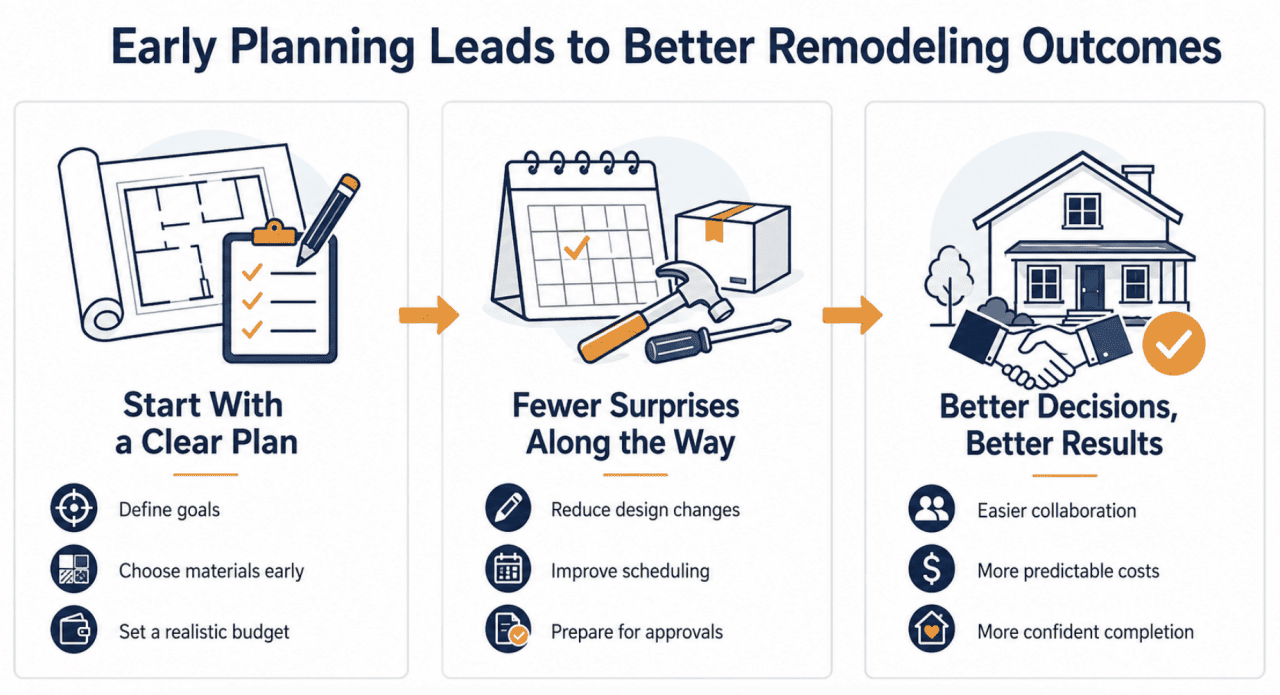
One-quarter of respondents admitted that they had not even decided on a specific budget before beginning the remodeling work. Such a lack of foresight creates the conditions in which overspending and delays are incredibly likely.
The homeowners who created budgets during the planning phase but didn’t stick to them cited a few reasons for the mistake: 35% went over budget because they chose higher-end materials midproject instead of locking them in early, while 32% cited unanticipated project complexity, and 31% outright changed the project or design scope during construction. Early planning eliminates many of these midproject expenses. Finalizing decisions in advance allows time to assess viability and check affordability. It also ensures material orders are placed with a sufficient window to account for last-minute supply chain delays.
According to CMK Construction, a kitchen and bathroom remodeling specialist, more homeowners are choosing to outsource the planning entirely to professionals. With longer lead times for materials and often full order books for the most reputable operators in this industry, there’s actually more time available to most clients between the start of planning and when work commences, so having a properly finalized set of choices for design and materials is more common.
Early planning also affords contractors the necessary runway to navigate complex local regulations and successfully secure vital municipal building permits before construction begins. Furthermore, finalizing project scopes well in advance allows teams to reliably schedule specialized subcontractors, such as electricians and plumbers.
Because the construction sector is currently facing severe labor shortages across the industry, locking in these highly requested professionals early prevents extensive delays that routinely derail poorly planned residential remodeling schedules and budgets.
Reacting to Market Realities
The same Houzz report highlights shifting financial realities across the market. While median remodeling spending fell to $20,000 in 2025, spending on the top 10% of high-end projects rose 7% to $150,000. Because these figures do not account for inflation, the real-world financial gap between median and high-end projects continues to widen.
The Houzz report, which singles out typical spending across remodeling projects, shows that the median figure here has actually fallen in recent years, sitting at $20,000 in 2025, down by $4,000 from 2023.
When so much money is on the line, and the potential for overspending is so high, early planning must be prioritized to sidestep the most likely outcome. Similarly, with 91% of respondents who are in the process of planning a remodeling project stating that they will be recruiting a contractor to handle the work for them, rather than taking the DIY route, rigorous planning and budgeting enable smoother relationships with professionals, rather than creating potential friction points if changes are requested and costs escalate.
Turning Intentions into Actions
The data showing that early planning has a beneficial impact on home remodeling projects, and that the benefits are exponential with budget and the intended level of materials and finishes, is compelling. What’s necessary now is for homeowners to take on board what analysts have reported, and act.
Indecision often paralyzes the initial stages of a remodel. What should spur anyone to act sooner rather than later is not only the knowledge that doing so will deliver better outcomes, but that it also provides an opportunity to decide once and for all if this is the type of project the homeowner is truly prepared to undertake.
This story was produced by CMK Construction and reviewed and distributed by Stacker.
