Hong Kong democracy activist Joshua Wong faces longer prison sentence after second national security guilty plea

By Chris Lau, CNN
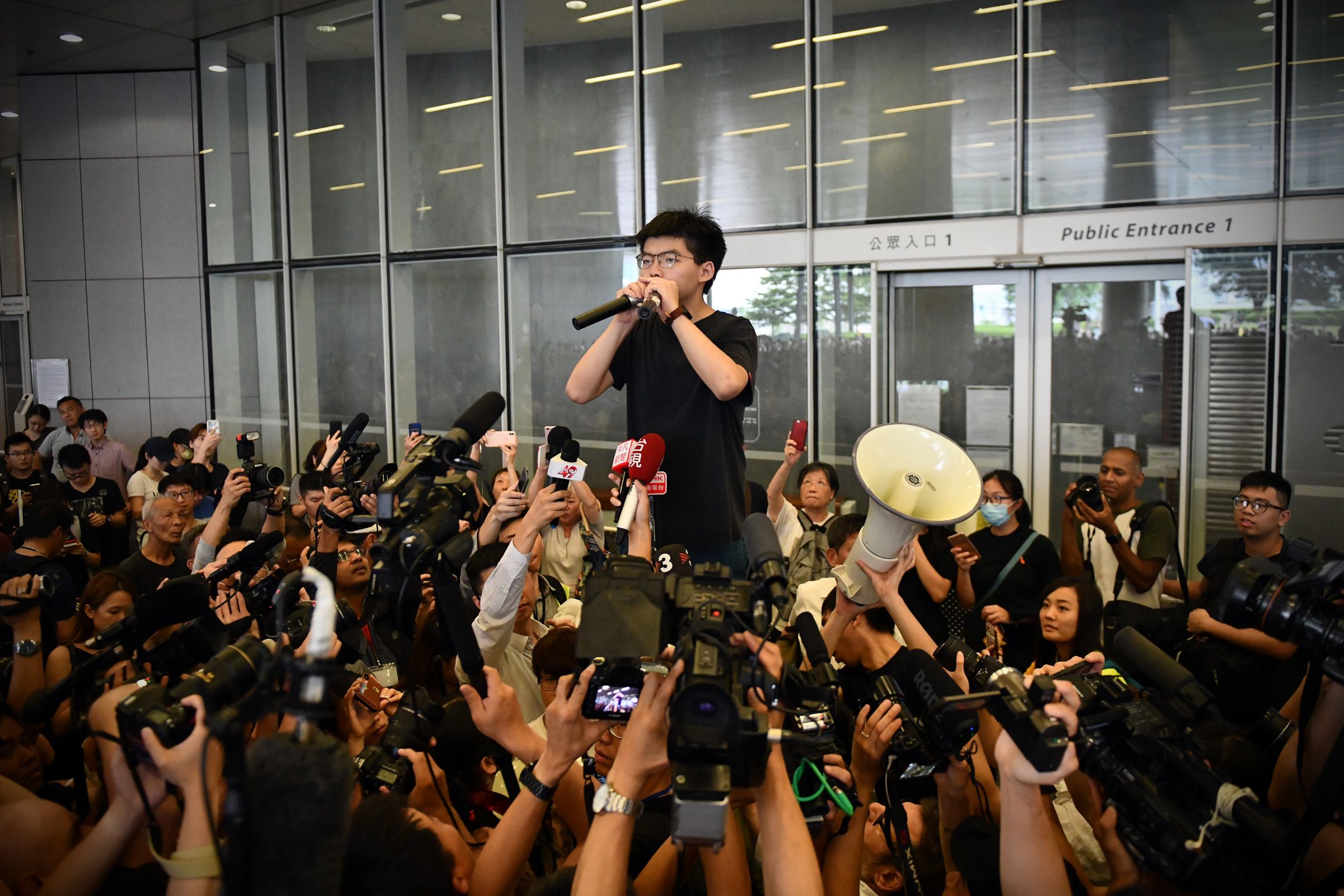
Hong Kong (CNN) — Joshua Wong, the former teenage activist who became a key leader of Hong Kong’s democracy movement, faces the prospect of many more years in prison after he pleaded guilty on Wednesday to the latest national security case brought by prosecutors.
Wong, now 29, was accused of conspiring with fellow activists to invite foreign sanctions against China and Hong Kong in 2020 – the year Beijing introduced a national security law which critics say put political freedoms in the city into deep freeze.
Wong is already in prison, serving a sentence of 4 years and 8 months, after pleading guilty in a landmark subversion trial in 2024. He was due for release in January. His latest case was heard Wednesday at Hong Kong’s High Court, where sentences of up to life can be imposed.
Wong and fellow pro-democracy activists have previously been labeled “separatists” by Beijing officials, who imposed the sweeping national security law after huge and sometimes violent pro-democracy protests convulsed the international financial hub in 2019.
The law tightened Beijing’s oversight of Hong Kong, a former British colony, and both governments say it has helped “restore” stability. But rights groups say the law has stifled dissent and made any criticism of the government fraught with risk.
On Wednesday a judge selected by the government to handle national security cases heard the prosecution outline details of the charge.
Prosecutors said that, prior to the National Security Law’s (NSL) imposition, Wong had joined others to lobby for a law in the United States that would allow Washington to sanction Hong Kong and China. This happened through social media campaigning and through meetings with US politicians, including former House Speaker Nancy Pelosi and then Senator Marco Rubio. They also lobbied other countries to impose sanctions.
Their plan, “International Battlefront,” continued after the law was enacted, prosecutors said, with the US sanctioning more than a dozen Hong Kong and Chinese officials after 2020.
During mitigation, Wong’s lawyer noted that the activist had already spent the past six years in prison on various charges, all of which he had pleaded guilty to.
“He has had a lengthy opportunity to reflect on his action, to reflect on the path that he took,” Derek Chan said.
Chan conceded the sentence could be up to 10 years, but urged the judge to reduce that by half, to pass a sentence that “gives the defendant some hope and a future to look forward to that will not be crushing.”
The court then adjourned for sentencing at a later date. As he was led from the dock, the bespectacled Wong waved to the public gallery, saying “Bye bye.”
A Hong Kong government spokesperson dismissed international criticism of Wong’s prosecution.
“The lawful exercise of free speech must not be conflated with taking actions to collude with a foreign country to impose ‘sanctions’ to harm one’s own country,” they said.
Learning guitar behind bars
Security was tight around the court complex, with police officers registering and searching dozens of people lining up outside.
Among them was Gloria Cheng, 32, Wong’s friend.
“This is not the first time for him and there were others before him,” she said, referring to prosecutions of other opposition figures.
“It really shows the state of affairs in Hong Kong now.”
With limited seats inside court, supporters took turns entering, to catch a glimpse of Wong, and left after waving to him to make room for others.
Louis Lee said he had been visiting Wong in jail, and said the activist tried to stay positive by studying, working out and learning to play the guitar.
He said Wong was devastated when he learned be had been charged with a national security crime for a second time.
“We are very upset because no one would like to spend another day in prison,” Lee said.
Teenage activist
Wong rose to prominence in 2012 at the age of just 15, when he led sit-in protests with his friends to successfully overturn a government plan to introduce Chinese civic education in the city’s schools.
At the time, critics feared such an education amounted to propaganda by Beijing. The curriculum is now compulsory in every school, under the Beijing-imposed NSL.
Two years later, Wong became one of the key leaders of the city’s Umbrella Movement protests that rallied thousands of predominantly young people to the streets to call for greater democracy by blocking major thoroughfares for 79 straight days.
He was renowned for his fiery public speaking, and drew large crowds of supporters.
He subsequently tried to fight for democracy by entering politics, but his candidacies were repeatedly blocked.
In 2016, he co-founded pro-democracy party Demosisto, which successfully sent co-founder Nathan Law to the city’s Legislative Council as its youngest member, although Wong was banned from running due to his young age. The party announced its disbandment hours after Beijing passed the NSL, with Law revealing days later he had left Hong Kong.
Law is now one of dozens of democracy activists overseas who are wanted by Hong Kong’s national security police and have had a cash bounty put on them.
Authorities disqualified Wong when he tried to run again in 2020. He was later arrested and charged along with dozens of others for taking part in unofficial primaries held to screen candidates for Legislative Council elections.
In what was widely known as the “47 case,” after the number of opposition figures on trial, prosecutors said Wong and others subverted the Hong Kong government in 2020 by engaging in a primary election – a common practice in many democracies.
At the time, Hong Kong authorities said the primary vote was a “vicious plot” intended to “paralyze the government and undermine state power,” and accused those who took part of intending to use their mandate to block legislation indiscriminately.
Of the 47, most pleaded guilty while 14 were convicted and sentenced to up to 10 years in prison, after a 2024 trial that marked the single largest prosecution of pro-democracy activists under the NSL. Two were acquitted.
Since the NSL came into effect, civil groups have disbanded, and some independent media outlets have been shut down. The city’s legislature now comprises only pro-Beijing loyalists, while most pro-democracy figures are either in jail or in exile overseas.
Just last month, two key organizers behind what used to be the only large-scale public commemoration of the 1989 Tiananmen Square massacre on Chinese soil were found guilty of inciting subversion.
The-CNN-Wire
™ & © 2026 Cable News Network, Inc., a Warner Bros. Discovery Company. All rights reserved.
