Tasmanian tiger skull shows it was different than any living mammal

By Ashley Strickland, CNN
(CNN) — Hunters wiped out thylacines, commonly known as Tasmanian tigers, in Australia nearly a century ago. But a myth about these shy, semi-nocturnal predators may have been behind the species’ extinction.
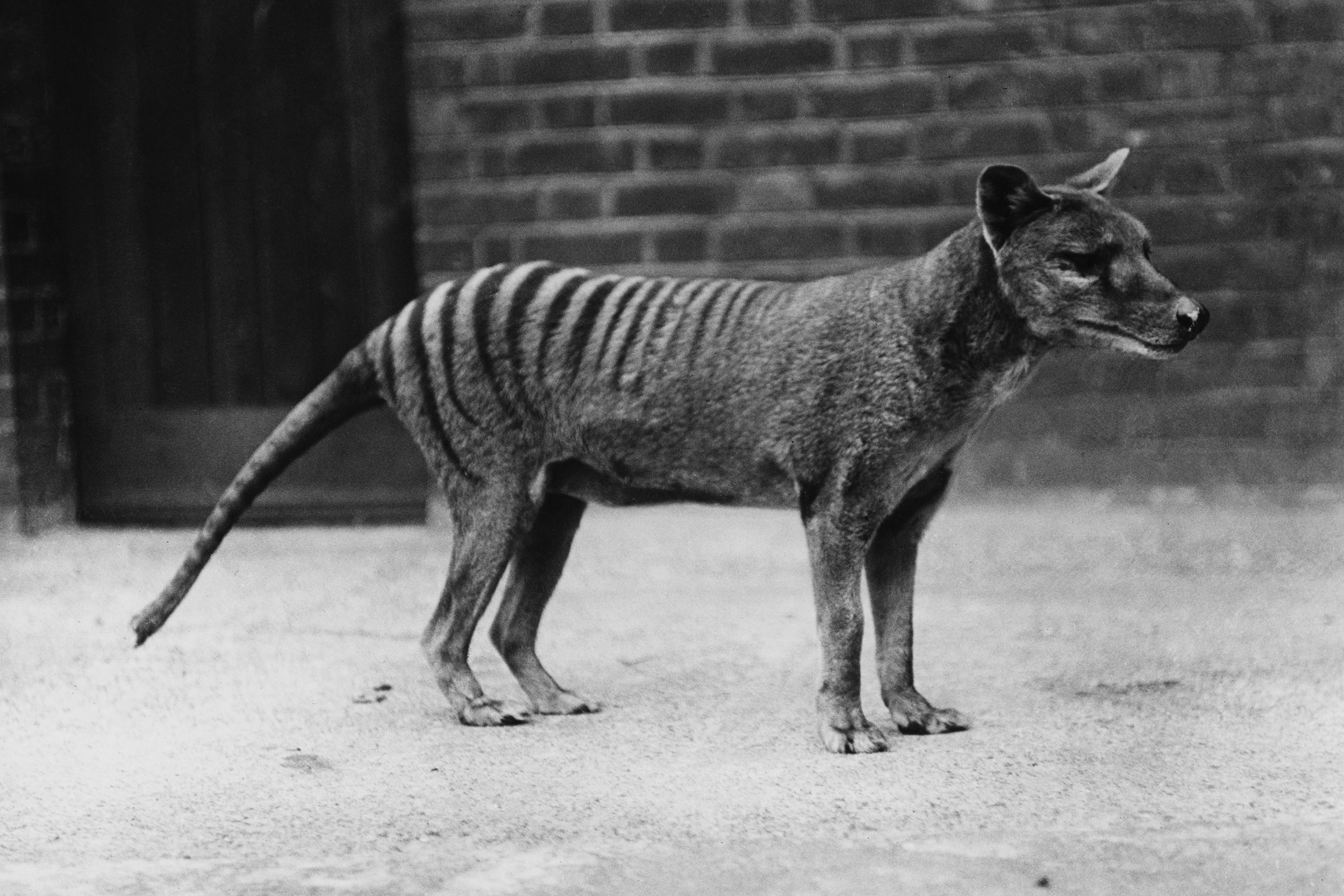
Thylacines had a strong resemblance to wolves — so much so that they were given the species name cynocephalus, meaning “dog-head.” Along with the physical likeness came the assumption that the animals posed a similar threat to livestock. Now, new research shows that Tasmanian tigers had specialized feeding adaptations that likely prevented them from hunting the livestock they were accused of attacking.
“The mostly British colonists of Tasmania tended to view unfamiliar wildlife as primitive copies of more familiar European species,” said Dr. Vera Weisbecker, lead author of a study published Monday in the journal Nature Communications, in an email. “Thylacines reminded them of wolves, so they decided that thylacines were a danger to livestock and put a bounty on its head.”
Thylacines disappeared about 2,000 years ago everywhere except the Australian island of Tasmania, according to the National Museum of Australia. When settlers began establishing sheep and cattle farms there in the 1800s, they exterminated the distinctively striped thylacines, blaming them for livestock losses that were actually due to feral dogs and human mismanagement.
The last thylacine living in captivity died from exposure in 1936 at the Beaumaris Zoo in Hobart, Tasmania — shortly after the Tasmanian government belatedly granted the species protected status.
A new analysis of thylacine skulls highlights just how different Tasmanian tigers were from wolves — or any other living carnivorous mammal. A unique combination of skull and jaw features suggests they hunted small, rabbit-size prey rather than larger animals such as sheep.
“Thylacines were in fact more closely related to kangaroos than to dogs,” said Weisbecker, professor of evolutionary biology at Flinders University in Australia. “They were marsupials whose ancestors separated from the other mammals long before the dinosaurs went extinct.”
The findings add to growing evidence that Tasmanian tigers were quite different from initial assumptions — and reveal the complexities of trying to understand an extinct species.
Large skull, quick bite
While scanning a dataset she had already published, Weisbecker noticed unusually large skull measurements and worried she had made an error.
“I even sent a student to our teaching collections after-hours to check, but this confirmed that thylacine skulls were tremendous,” she said. “That’s when I started wondering what was going on with this animal’s skull.”
Previous research has shown that thylacines were about half the size of past scientific estimates, more similar to large coyotes than hulking wolves. A 2020 study by one of Weisbecker’s collaborators determined they were about 37.5 pounds (17 kilograms) on average — not 65 pounds (29.5 kilograms) as once suspected.
But the thylacine’s oversize skull was about as large as that of a gray wolf, the authors of the new study found. They measured and compared the skulls of thylacines, foxes and wolves during the analysis.
“But while it was big, it wasn’t really shaped like the skull of a big predator,” said study coauthor Dr. Douglass Rovinsky, associate research scientist in the School of Biological Sciences at Monash University and researcher at the Australian Museum, in a statement. “Instead, the thylacine’s snout was long and slender, almost delicate — not robust like the snout of a grey wolf. It very much looks like the snout of a fox or jackal, which can be much smaller than thylacines.”
A combination of a large skull and a long upper jaw and snout suggests the thylacine likely used a quick, snapping motion to grab small or medium-size prey, such as bandicoots or rabbit-size marsupials.
“The longer a jaw is, the faster its tip moves when an animal bites. This increases the impact of the strike,” Weisbecker said. “We think that the thylacine’s huge skull size allowed it to withstand these bite forces.”
But when comparing the feeding style of thylacines with that of other living predatory mammals, the researchers turned up no matches, so they looked for comparable traits elsewhere across the animal kingdom, she said.
“Its skull was functionally more similar to living and extinct fish-catching species, like some crocodiles,” Weisbecker said. “This includes long, large jaws that can take high snapping impacts, but are not too fragile to withstand the stresses of struggling prey.”
The study provides compelling evidence that the thylacine was not simply a marsupial version of a gray wolf, said Love Dalén, professor of evolutionary genomics at Stockholm University in Sweden. While Dalén has researched thylacines in the past, he was not involved in the new study.
“Its distinctive skull suggests it used fast and powerful bites to catch small and agile prey, rather than grappling with large animals like grey wolves do,” he wrote in an email. “It’s a fascinating example of how two animals can look remarkably similar at first glance, while in reality functioning in fundamentally different ways.”
‘Resurrecting’ a lost species
Little is known about the ancestors of thylacines, which were the last survivors of an ancient marsupial lineage estimated to be more than 40 million years old. And the thylacine has no close living relatives, Weisbecker noted.
“There are some intriguing fossils suggesting that some of the thylacine’s skull traits evolved quite early, but we need to study them more to be sure,” she said.
Analyzing both recent and ancient thylacine skulls from across Australia could showcase just how diverse the species was before it disappeared.
“These stories matter because Australia has lost more mammalian species than any other country worldwide, and 40% of its marsupial species are threatened,” Weisbecker said. “My next research will aim to match these stark statistics with tangible facts about what irreplaceable biodiversity heritage we are at risk of losing.”
The Tasmanian tiger has become a key figure in the “de-extinction” efforts by one of Weisbecker’s collaborators, Professor Andrew Pask. Pask is the head of the Thylacine Integrated Genetic Restoration Research Lab at the University of Melbourne in Australia. He’s working with Dallas-based biotech company Colossal Biosciences to “resurrect” the thylacine by creating a hybrid animal, harnessing advances in genetics, ancient DNA retrieval and artificial reproduction.
Weisbecker is not involved in the efforts but said her main concern was ensuring Indigenous people would have custodianship of the animal and that their input would help shape the thylacine’s de-extinction plans.
“That said, de-extinction efforts have tremendous use — I would even say that the achievement of de-extinction isn’t the main impact here,” she said. “Reconstructing an extinct species requires groundbreaking insights about genes, gene expression, conservation genetics, and reproductive biology, which de-extinction efforts are currently undertaking with funding that would otherwise not be available.”
The-CNN-Wire
™ & © 2026 Cable News Network, Inc., a Warner Bros. Discovery Company. All rights reserved.
