The retirement fear gap: Who really fears running out of money?


Although fear or anxiety about retirement is often felt by those nearing the age limit,a new survey of 1,000 Americans commissioned by John Stevenson, a retirement-income specialist who sells annuities, shows that income level is a better predictor of who is most concerned about retirement income.
Americans earning less than $25,000 a year are nearly four times as likely as six-figure earners to say they are not confident in their retirement savings and are scared of running out of money.
And with that fear comes an even more uncomfortable finding: The people who fear retirement the most are the least likely to look at products to stop that from happening.
Retirement is An Income Problem
The survey finds that the lower the income, the higher the fear. More than one in four respondents earning under $25,000 said they have no confidence in their retirement savings and fear running out. Among those earning six-figures, fewer than one in ten said the same thing.
This contradicts the standard “countdown” to retirement, where age typically dictated the anxiety. It’s being felt by people of all ages in lower incomes.
Only 1 in 5 Believe the 401(k) works
The 401(k) made workers believe they were working for something. It was pitched as a retirement fund with more control than a pension. Just 21.3% of respondents say the plan gave people more control, with more than four in 10 saying it works better for higher earners.
Among low-income earners, 37.7% say the system works better for higher earners. The answer rises to 44% among those who earn $50,000 to $249,999.
This is important to note because only about 14% of workers in the private sector had access to pension benefits as of March 2025. So, for most workers, the 401(k) is the only option the workforce gives them, one which they believe doesn’t favor them.
Nearly Half Support Bringing Back Pensions
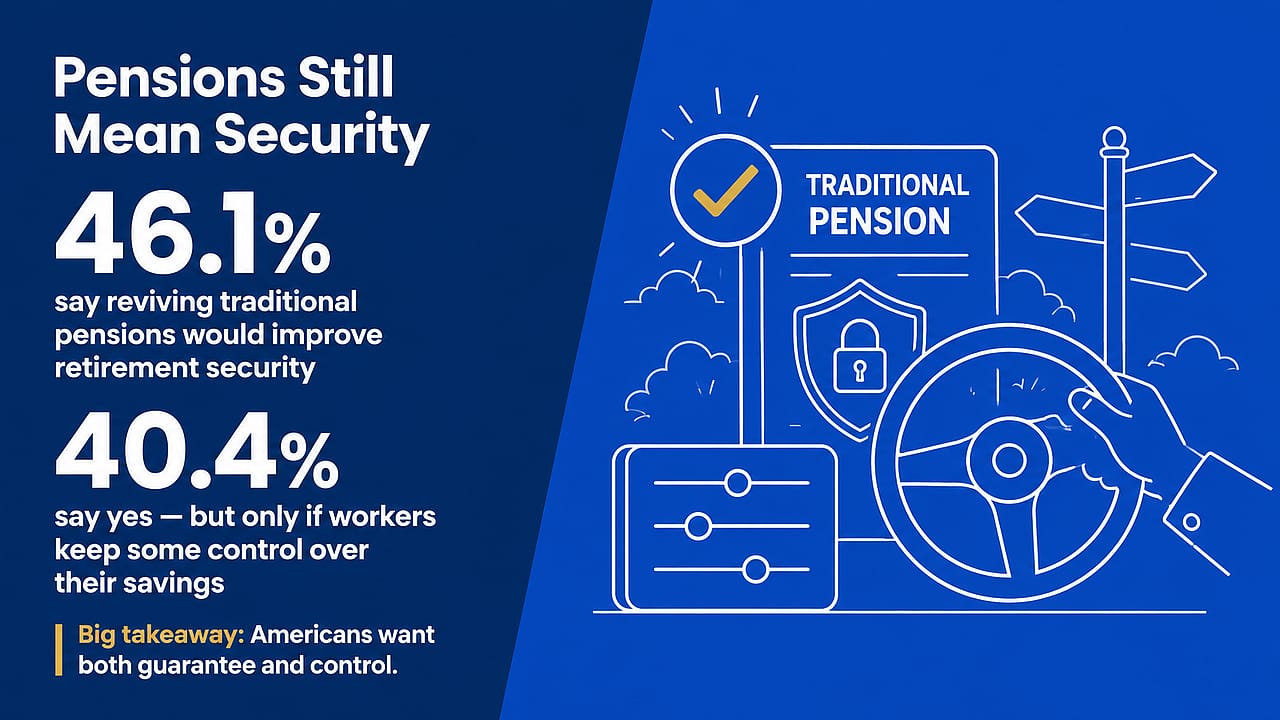
When asked if bringing back pensions would help strengthen retirement security, nearly half (46.1%) said yes. Another 40.4% said yes, with the condition that workers keep some control over their savings.
This support isn’t coming only from low-income earners. The answer stands across the income board. Among households earning $100,000 to $250,000, 49% said yes, pensions would strengthen retirement security, while another 41.6% said yes with the condition.
The answer with the condition is telling. People want the security of a pension and the control of a 401(k).
Those Most Afraid Are Least Likely to Look for a Solution
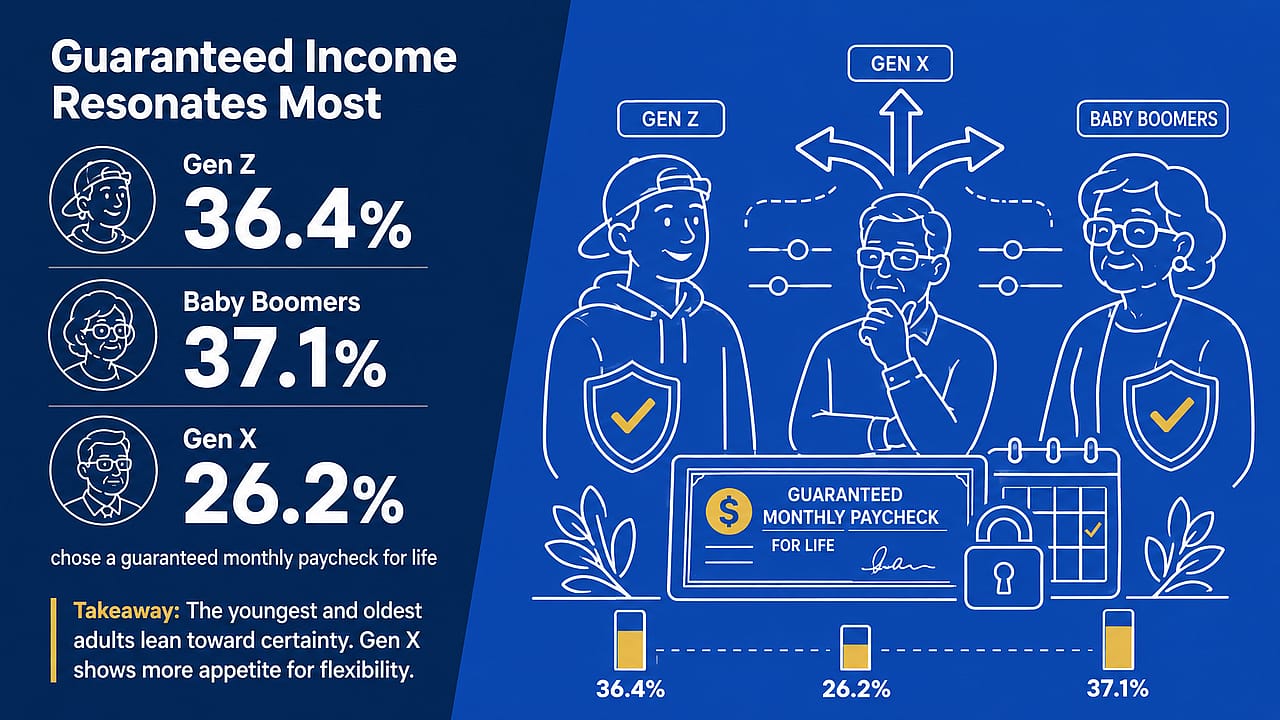
This brings the survey full circle. A third of respondents (33.8%) said they’d be very likely to explore a guaranteed monthly income if shown the exact parameters, with another 47% saying they would be somewhat likely. Transparency is the name of the game for most people.
But not for the ones who need it the most. Among those already saving for retirement, four in ten said they’d eagerly explore a guaranteed paycheck. Among those not saving, and worrying about retirement, less than a quarter said the same thing.
The fear gap is real, but in this case, fear does not cause fight or flight. It causes paralysis, a state where people know they need a solution but are less willing to explore it.
Methodology
To understand how Americans approach retirement security and guaranteed income, John Stevenson surveyed 1,000 U.S. adults across the country in July 2026 through Pollfish, an online survey platform. Participants answered questions about their views on traditional pensions and 401(k) plans, their confidence in their own retirement savings, the tradeoffs they would accept between guaranteed income and flexibility, and what would make them comfortable exploring a guaranteed monthly paycheck. Responses were analyzed by demographic groups, including age, gender, household income, and education level, to identify trends and disparities.
This story was produced by John Stevenson and reviewed and distributed by Stacker.
