A mystery skeleton found in a Roman sarcophagus at Westminster Abbey may finally have an identity

By Mindy Weisberger, CNN
(CNN) — A centuries-old stone coffin discovered more than 150 years ago at London’s Westminster Abbey sparked a question that has endured ever since: Who’s inside? Now, archaeologists have clues that point to a respected medieval figure who was not the burial’s original occupant.
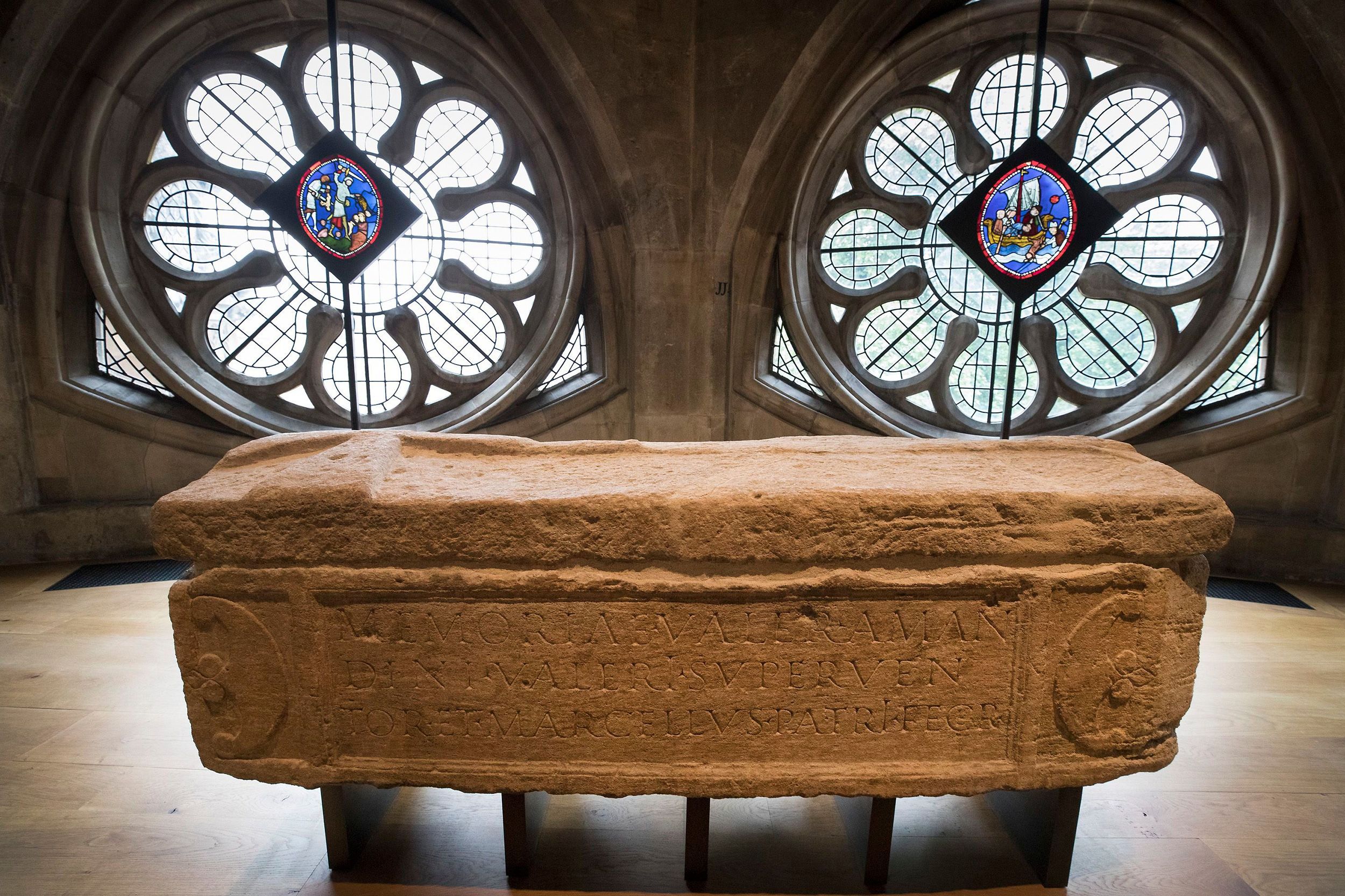
Prior research had determined that the sarcophagus dated to the Roman period, around the fourth century, and a three-line Latin inscription dedicated it “to the memory of Valerius Amandinus.” Given the coffin’s high quality, Amandinus was probably an important resident of London, but nothing is known about his life and deeds.
However, a cross of a late Anglo-Saxon style carved on the sarcophagus lid and measuring 5.9 feet (1.8 meters) long was likely made at least 600 years later. The symbol’s presence sowed doubts about the age and identity of the skeleton inside, according to Warwick Rodwell, a consultant archaeologist at Westminster Abbey.
He conducted a new analysis of the remains and found the coffin’s occupant was likely a medieval monk or abbot of Westminster. Rodwell reported his findings October 20 in the Journal of the British Archaeological Association.
Workers first discovered the burial at the abbey in 1820. During its excavation, they broke the lid into six pieces, and their rough handling damaged the skull. The bones were swept into a pile and left in disarray, perhaps disturbed by looters while the lid was open. Then, the coffin and its contents were reburied without being catalogued or studied.
The sarcophagus was “found” a second time in 1869 during a renovation project, and it was moved from the abbey’s North Green region to the East Cloister. (Charles Dickens Jr., eldest son of the famous novelist, wrote about seeing the sarcophagus at the abbey in 1879, according to the study.) It was later relocated to the base of the abbey’s northwest tower, a task that took more than 36 hours due to the coffin’s weight.
Rodwell first learned of the coffin’s history in 2009. When he found out that the sarcophagus was scheduled for cleaning and conservation in 2016, in preparation for display in new galleries that were being constructed in the abbey, he seized the rare chance to revisit the mysterious burial.
“I saw this as an opportunity to take a fresh look at it, and to see what was inside — if anything — after 150 years of being sealed up,” he told CNN in an email.
Identifying an abbot
Rodwell found the bones were still jumbled together inside the coffin, which was hewn from a single block of limestone and measured about 7 feet (2 meters) long, with walls about 4 inches (10 centimeters) thick on average. The skeleton was about 90% complete, and the skull had been reconstructed when the coffin was last opened in 1869, he wrote in the study.
Skeletal analysis hinted that this was a man who died between the ages of 35 and 49 years, and radiocarbon dating of the bones placed him between A.D. 987 and 1052. His teeth were in good condition. And while some bones showed evidence of healed fractures, osteoarthritis and gout, there was no sign of serious disease or injury that might have caused the man’s death.
When the researchers removed the skeleton and cleared the coffin of soil and rubble, they were surprised to find a rectangular patch of lime, a compound thought to accelerate decay and trap “miasmas,” so-called toxic vapors that were erroneously linked to disease. The shape of the lime patch suggested that the body had been inside a rectangular wooden coffin that was then filled with lime before being placed in the sarcophagus, Rodwell said. “This had not been suspected, and the timber coffin had totally rotted away.”
The practice of covering a body in lime was rare in the Middle Ages and typically reserved for high-status burials, he added.
That clue and the cross on the coffin led the researchers to reason that the skeleton probably belonged to an important man, most likely the abbot of Westminster. Two historically identified candidates arose for that period: Ælfwig, abbot from A.D. 993 to around 1020, and Wulfnoth, who became abbot in 1020. Ælfwig is a slightly stronger contender, according to the study, as he was known to have been a monk at Westminster before becoming abbot and may therefore have had a clearer connection to the church.
“No single clue clinched the matter,” Rodwell said. “It was a case of assembling and weighing all the strands of evidence.”
Ancient recycling
But why would the abbot of a prestigious church be buried in a used Roman coffin? Rodwell said this could actually be a tribute to his elevated status.
“In the late Saxon period stone coffins were hard to come by — the industry for making them had died out,” he said. “Acquiring a secondhand stone coffin was considered a ‘prize.’”
So valued were these coffins, he added, that in the seventh century, British monks from an abbey in Ely traveled to a Roman cemetery in Cambridge and dug up a stone coffin to take back with them for their deceased abbess, Æthelthryth.
Another example of a repurposed stone coffin is the elaborate fourth century sarcophagus currently in the Vatican Museums that is rumored to hold the remains of Helena, mother of the emperor Constantine the Great, said Dr. Simon Roffey, a reader in medieval archaeology at the University of Winchester in the UK. Carved with a military scene of Roman soldiers trampling barbarians, the coffin was likely intended for a man.
Still, further research is needed to fully explain the motives and rationale behind the reuse of pagan tombs and sarcophagi during the medieval Christian period, Roffey told CNN in an email. He was not involved in the new research.
While Ælfwig the abbot isn’t exactly a well-known figure who looms large in the public imagination, this discovery nonetheless untangled a mystery that has stymied academics since 1869 and fills a significant gap in the Anglo-Saxon history of Westminster Abbey, “the most important church in Britain,” Rodwell said.
The-CNN-Wire
™ & © 2026 Cable News Network, Inc., a Warner Bros. Discovery Company. All rights reserved.
