Putin’s false claim of the capture of one Ukrainian town exposes the slow pace of Russia’s bloody advance
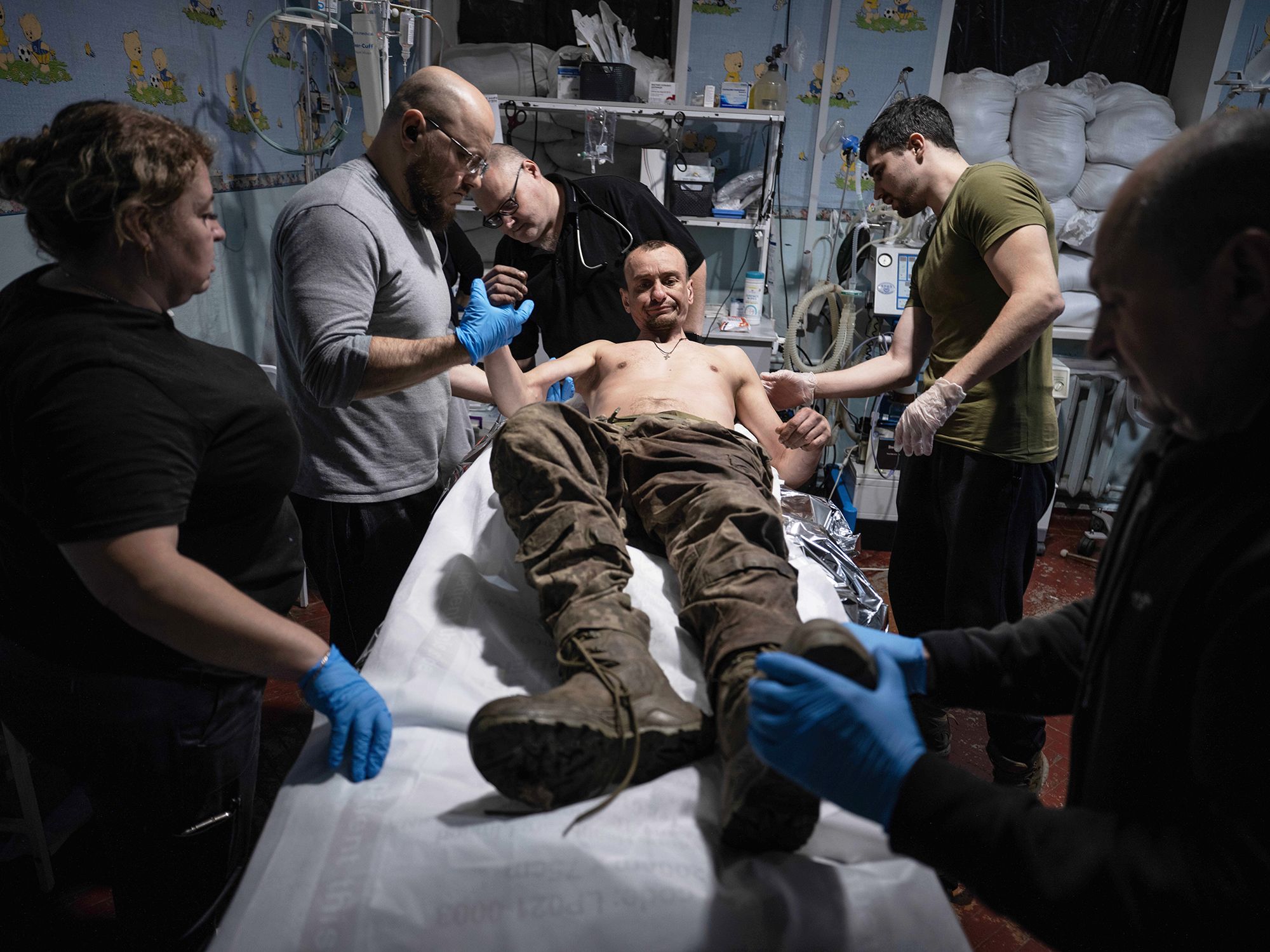

By Nick Paton Walsh, Victoria Butenko, Daria Tarasova-Markina and Luke Unger, CNN
(CNN) — It is the fate of just one town, over a year, but provides a rare insight into Russia’s ill-fated war of choice.
The slow and costly infiltration of Kostyantynivka, key to Moscow’s advance in Ukraine’s eastern Donbas and claimed as occupied by the Russian defense ministry on July 3, lays bare the persistence of the Kremlin’s forces and the devastating casualties they will tolerate to obtain even the smallest of goals.
On July 3, the Ministry of Defense posted a series of videos of Russian troops at various points inside the town’s center, waving Russian flags, to bolster its assertion they had taken the town. The false claim – contradicted by recent videos, testimony from Ukrainian troops, and independent mapping of the frontlines – was one of several made in past months by Russia’s leaders, seeking to suggest their battlefield progress was greater than it is, to perhaps persuade their domestic audience, or counterparts in the White House, that their military campaign had not stalled.
Ukraine’s President Volodymyr Zelensky swiftly seized on the falsehood, and urged Russian President Vladimir Putin to meet with him in the town to talk peace, if indeed it was under Moscow’s control.
CNN, which has reported in or near Kostyantynivka twice over the past year, has used geolocated videos and testimony, to show the horrific cost and slow pace of the Russian advances that led up to the false claim of the town’s capture. The town’s fate exposes both the dogged, relentless nature of Moscow’s assault, and the relatively minute nature of the victories it claim, even if falsely.
July 29, 2025
Mapping by the independent Ukrainian analysts Deep State shows Russian forces outside the town, trying to push in. The road into the town is already lined with fishing nets, to protect traffic from Russian attack drones. Cars safely drive into town and the market, in its center, remains busy, despite the occasional threat of drones.
A CNN team that visited in July last year, found streets bustling with civilians, although some were reluctant to be filmed, perhaps fearing future Russian occupation and being sanctioned for “cooperating” with Western media.
November 2025
By the first winter months, the map shows the so-called gray zone of disputed territory edging closer to the town center. Russia’s assault with airstrikes had escalated. Videos posted by Ukrainian forces show apartment blocks in the town’s southwest in flames.
And a Russian drone captures the damage caused by an airstrike, just a few streets away.
But the Ukrainians are still confidently inside the town center, with the General Staff posting a video of one officer casually standing in Victory Square in November.
Russian footage posted from that time shows what appears to be their infantry’s point of view from inside an apartment complex courtyard, off the town’s Gromov Street, on the southwestern edges again.
January 2026
It is in the latter days of the year that Russia appears to take its largest steps forward, recorded by Deep State in the first week of 2026. The gray zone has reached the town and two separate Russian prongs edge closer to its main access roads.
Two key factors inform the extent of Moscow’s progress. The range of attack drones – either the tiny First-Person View drones that target individuals or vehicles, or the larger-payload machines that hit buildings – grows monthly, slowly putting the safe space around Kostyantynivka at a greater distance and complicating its defense by Ukraine. More significantly, at this time Western officials began to echo Ukrainian claims that Russia was experiencing up to 35,000 dead or wounded on the battlefield every month.
This staggering figure – an apparent result of both a Ukrainian mandate to kill as many soldiers as possible with its drones and the continued use of brutal “wave” assault tactics by Moscow – exposes the likely human cost of Russia’s small advances around Kostyantynivka.
The videos posted in January show, however, that Kyiv’s forces are very much still in the center, near the embattled railway station, at the end of the month.
By February, white phosphorus, a horrific munition whose use in warfare over residential areas is considered illegal in humanitarian law, rains down over the apartment blocks of the southwest, suggesting the outskirts are home to the heaviest combat.
All the same, the Ukrainians post videos showing they are still in the central-south area of the town.
It is clear by this stage that much of the civilian population has left and the town is slowly being reduced to rubble. A video posted in April shows that where Ukrainian troops stood casually in November has been reduced to the skeletal remains of buildings and ruins, raising the question of the economic value of the areas Russia fights for.
May 2026
CNN experienced the change in Russian drone reach firsthand in May, in a grueling five-hour return journey on foot along the main entrance road into Kostyantynivka, which a year earlier was safely accessible under the cover of fishing nets. By May, the nets remained but the road was littered with the charred remnants of cars, struck by drones, and automated robots used to deliver supplies to the front line.
The five-kilometer (3.1-mile) walk down what had become known as the “Road of Life,” from the next main town of Druzhkivka, to the outskirts of Kostyantynivka, was mostly carried out on foot, a journey during which Ukrainian troops had to constantly duck into the foliage and hope the Russian attack drones overhead would pass them by. Vehicles on the road had become targets and the team passed the burned-out car where an officer from the unit was killed just days earlier.
The increased peril on the road, despite Ukrainian troops still being in the town’s center, reflected Russian drones having developed greater range over the past few months and the technological advances on both sides that constantly reconfigure the battlefield. The map shows the gray zone now deep inside the town and Russian forces truly inside its southwest.
July 2026
Two months later, the Russian military would claim the town was theirs and post videos in apparent evidence to that effect. However, it is clear on the July 3 map that they still have to exert control over significant parts of it.
A week after the claimed capture, Ukraine’s 19th Army Corps posted a video on Telegram of its drones targeting Russian forces in the rubble of the city, killing one “occupier.” The post says: “The enemy paints victories on screens, but in practice, they are destroyed by our units. The city stands. Defense continues.”
This is the lesson of Kostyantynivka: Russia may slowly be taking it, at huge cost. But it covers a mere 66 square kilometers (25.5 square miles), while Russia’s territory amounts to 17 million square kilometers (6.6 million square miles).
It is unclear exactly how many Russian or Ukrainian lives have been lost to the fight. But images of the town show its reduction to rubble.
The town has some strategic importance, in that its capture would enable Moscow’s forces to edge closer to the last main population centers of the Donbas region that Putin so covets – Kramatorsk and Sloviansk. But the capture of both these towns is likely to involve a similarly gruesome and lengthy fight, putting an even optimistic assessment of attaining this key Moscow war goal at least a year away.
A year of horrific violence in Kostyantynivka eats at the weakness at the heart of Putin’s war-plan: how long can he sustain Russian public confidence in a conflict where the smallest achievements must be falsely claimed and in reality remain out of reach?
The-CNN-Wire
™ & © 2026 Cable News Network, Inc., a Warner Bros. Discovery Company. All rights reserved.
