Flávio Bolsonaro inherited his father’s right-wing movement. Can he win Brazil’s presidency?

By Alessandra Freitas, CNN
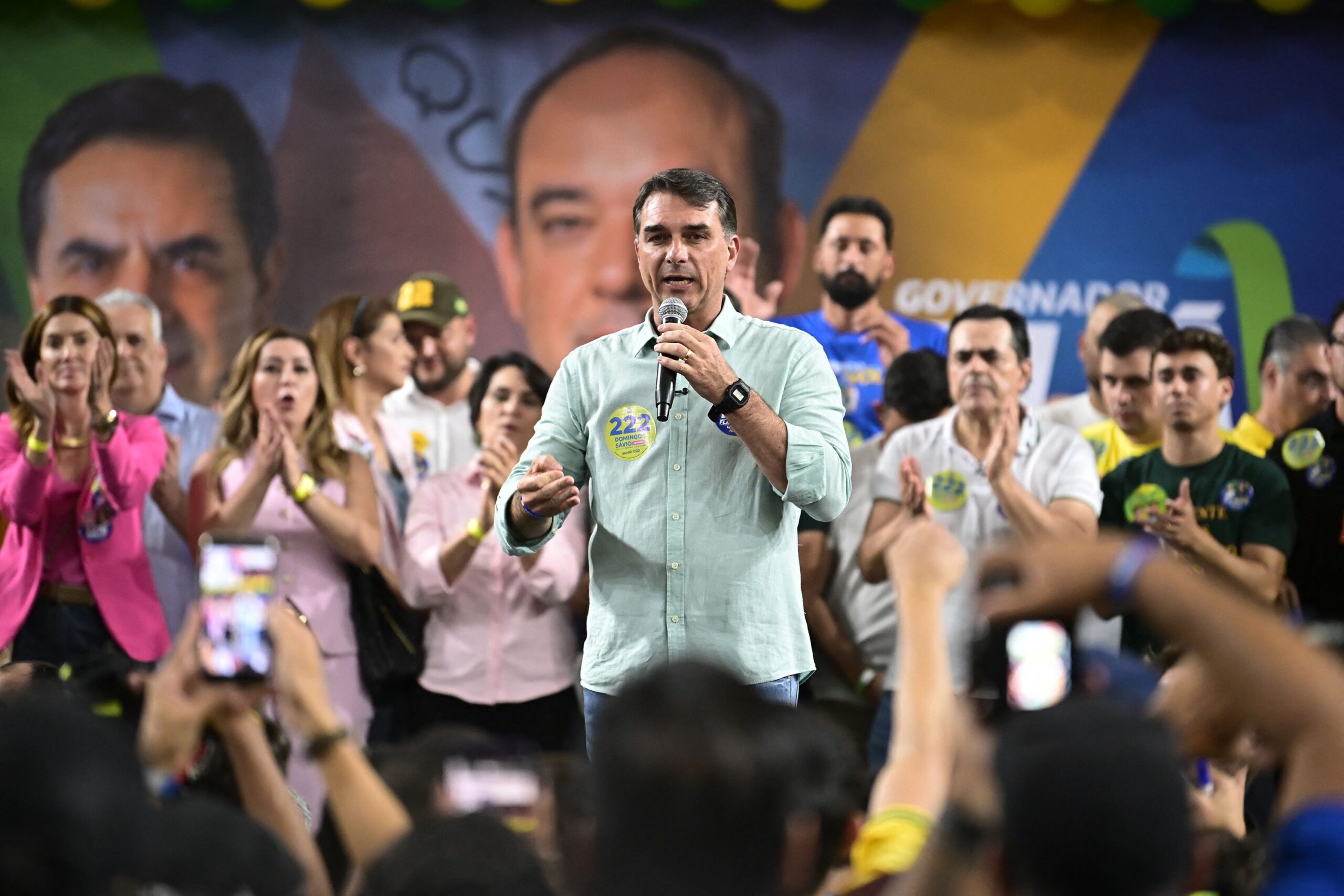
(CNN) — Standing atop a truck equipped with loudspeakers on Rio de Janeiro’s Copacabana Beach, Brazilian senator Flávio Bolsonaro officially launched his campaign, addressing the inevitable comparison with the man whose footsteps he is trying to follow.
“I know you are looking at me right now and thinking of someone,” he told thousands of supporters gathered on August 16 in the city where his political career began. “I know I look like him, but it is difficult to compare Pelé’s son to Pelé.”
The reference to Brazil’s most famous soccer player drew laughter, but it captured the challenge at the heart of Bolsonaro’s presidential candidacy: how to capitalize on his similarities with his father, ex-President Jair Bolsonaro, while convincing voters that a different Bolsonaro can inherit the movement built around him.
The physical resemblance is obvious. Flávio shares his father’s light-colored eyes, dark hair, defined features and some of his gestures when speaking. But as he campaigns to succeed the man who transformed Brazil’s right, he has struggled to connect with voters in the same way his father did.
That is why, for much of the rally, escaping Jair Bolsonaro’s shadow did not even seem to be the goal.
Flávio played recordings of the former president, promised to continue his legacy and said he had “humbly” accepted the mission his father had entrusted to him.
Convicted of more than 27 years in prison for plotting a coup after his 2022 electoral defeat, Jair Bolsonaro has entrusted Flávio with continuing his legacy, while maintaining his innocence and hoping that his son’s path to the presidential palace could also lead to his own freedom.
At 45, Flávio now faces a task that even his father could not accomplish: defeating Brazil’s leftist President Luiz Inácio Lula da Silva, who, at nearly 81, is seeking a fourth and likely final term.
Bolsonaro secured a surprise lead over Lula during the first-run election vote earlier in October. But neither secured the 50% needed to avoid a runoff, now set for this Sunday.
But just days before the vote both candidates face controversies — corruption allegations, family disputes and a growing institutional crisis involving the Supreme Federal Court and figures across the establishment — while polls indicate a tight race with Bolsonaro in the lead.
A more moderate Bolsonaro?
Flávio Nantes Bolsonaro was born in 1981 and is the eldest of Jair Bolsonaro’s five children. A lawyer by profession, he was elected to the Rio de Janeiro state legislature at just 21, long before his father’s rise turned the family name into one of Brazil’s most powerful political brands.
Flávio served four terms before reaching the Senate in 2018, the same election in which his father won the presidency.
He built his political career in Rio de Janeiro — a state with a long history of organized crime and violence — focusing primarily on hard-line public security policies and defending police officers and other security forces.
However, Flávio is perceived as a more moderate and conciliatory Bolsonaro. “During the various crises of Jair Bolsonaro’s government, Flávio appeared to be the family member with some willingness to engage in dialogue,” said Octávio Amorim Neto, a political scientist and professor at the Getulio Vargas Foundation.
During his father’s repeated clashes with Congress and the Supreme Federal Court, Flávio cultivated relationships with lawmakers and acted as an informal bridge between his father and the Senate.
“Flávio has more tact than his father,” said Gilson Machado, Jair Bolsonaro’s former tourism minister, who has known the former president since the 1990s and Flávio for more than a decade. “He listens more.”
Machado, a longtime Bolsonaro ally, was arrested on June 13, 2025 as part of an investigation into whether he had attempted to help Bolsonaro’s former chief of staff and a key witness in the coup-plot case obtain a Portuguese passport and leave Brazil. Machado denied the allegations, and his pretrial detention was revoked that same day, although he still faces restrictions, including the retention of his passport.
Machado says he often spends vacations with Flávio in northeastern Brazil and that the senator loves fishing and is passionate about diving. “He is a fearless diver. He goes down to 30 meters (90 feet). I had never seen anything like it,” he said.
Machado also offered a glimpse into one of the main differences between father and son: Jair’s more reserved nature compared with Flávio’s more openly affectionate personality.
“Bolsonaro has never kissed his children,” he said. “Flávio, on the other hand, kisses his son; he has kissed his father. It is a different style.”
But a more moderate personal style does not amount to a more moderate political project.
In a 2007 speech, Flávio defended the militias that were expanding their control over parts of Rio at the time, describing them as a “new way of doing police work” that could provide security where the state had failed, in what is widely regarded as one of the most controversial episodes of his career.
“As a state lawmaker, he awarded medals to militia members,” Amorim Neto said. “That is one of the major stains on his record, even in the eyes of the right.”
A hard-line approach to crime is also a central element of his father’s movement, and Flávio has taken it to the national stage. His campaign puts security front and center, with promises to lower the age of criminal responsibility and toughen the response to violent crime. In March, he called for Brazil’s two largest criminal groups to be designated as terrorist organizations and then traveled to the United States in May to make the request directly to Trump, a measure rejected by Lula and the left, who consider it a threat to Brazilian sovereignty.
When the United States announced that the groups would be designated as terrorist organizations, Bolsonaro thanked Trump and Secretary of State Marco Rubio for what he described as a response to his request.
The message connects with voters’ main concern: A Quaest poll in August showed that 33% of Brazilians considered violence the country’s main problem, more than twice the percentage who mentioned the economy.
A family business
After Jair’s conviction left him out of the race, other prominent names emerged to take over the leadership of the right. But the former president pushed to keep the legacy within his own surname.
“Politics is the Bolsonaro family business,” Amorim Neto said, and two of the brothers with the longest political careers thus emerged as the leading contenders.
Eduardo Bolsonaro had built the strongest international profile among the brothers, cultivating ties with the MAGA movement in the United States and lobbying the Trump administration to pressure Brazil’s Supreme Federal Court over his father’s case. In July 2025, Trump called the case against Jair Bolsonaro a “witch hunt” and announced 50% tariffs on Brazilian imports. Nearly a year later, Brazil’s courts convicted Eduardo of coercion and sentenced him to four years and two months in prison. He remains in the US and risks being arrested if he returns to Brazil.
“That effectively left Flávio and his stepmother, former first lady Michelle Bolsonaro, as the leading contenders to inherit the family’s political leadership,” Amorim Neto said.
For the political scientist, Jair Bolsonaro’s final decision was to favor his own bloodline. “He ended up choosing the eldest son,” he said.
But the transition was not easy.
Flávio publicly clashed with his stepmother, the former first lady, a powerful figure on Brazil’s right.
A dispute over party alliances erupted publicly in June, when Michelle posted videos accusing her stepson of humiliating her politically during a phone call. The rift was particularly delicate because Michelle had built a strong network among conservative women and evangelical Christians, key constituencies for Flávio.
Flávio apologized, and the two publicly reconciled in July after weeks of efforts by party leaders to contain the dispute. By September, Michelle had returned to the campaign to support her stepson, asking her network of female supporters to help elect him.
Machado told CNN that their relationship is now “as good as it can possibly be.”
But the episode exposed a fragmented right and a divided Liberal Party, Bolsonaro’s political base.
A scandal that reaches everyone
The campaign is also facing other problems. A sweeping corruption investigation into the bankrupt private Brazilian bank, Banco Master, has become a backdrop to the election, reaching politicians across Brazil’s establishment, including the Supreme Federal Court, Lula and Flávio himself.
For Flávio, the scandal initially presented an opportunity to revive one of Bolsonarismo’s longest-running battles: its confrontation with the Supreme Federal Court, and particularly with Justice Alexandre de Moraes, who oversaw key investigations that ultimately led to Jair Bolsonaro’s conviction. Bolsonaro supporters have since portrayed Moraes as an ally of Lula, although he was not appointed by Lula and does not belong to his party.
Investigators uncovered a multimillion-dollar contract between Banco Master and a law firm owned by Moraes’ wife, as well as compromising messages that the bank’s president sent to a contact he had saved under Moraes’ name, according to CNN Brasil. It has not been established that Moraes received or responded to the messages, but the revelations gave Bolsonaro’s campaign enough ammunition to return to one of its most familiar arguments: that the left, and anyone associated with it, is corrupt.
“Today we have our No. 10 on the campaign trail,” Machado told CNN. “It is Alexandre de Moraes.”
CNN has reached out to Moraes for comment. He has previously denied receiving messages attributed to him, calling the association of his name with them a “false inference” aimed at attacking the Supreme Court.
Luciano Da Ros, a political scientist specializing in corruption and Brazil’s judicial system, said that for the Bolsonaro base, interest in Moraes’ possible involvement goes beyond the election.
“They hope this will eventually make it possible to overturn the conviction or invalidate his actions in the case on procedural grounds,” he said.
But in recent days, the scandal has also reached Flávio.
The Supreme Federal Court opened an investigation in July into the senator over alleged corruption and money laundering linked to Banco Master’s financing of “Dark Horse,” a film about Jair Bolsonaro. Flávio has denied wrongdoing and said his ties to Daniel Vorcaro, the former owner of Banco Master, were related to the film.
Bolsonaro beyond Jair
If elected, clashes with the judiciary are unlikely to end. Flávio has promised to seek a broad amnesty for his father and others convicted over the coup attempt, and to use the presidential pardon power if Congress does not act.
“That would mean another enormous crisis with the Supreme Federal Court,” Amorim Neto said.
A Flávio government is also expected to maintain much of his father’s international alignment, particularly with the US.
“Bolsonarismo is intimately linked to MAGA and Trumpism,” Amorim Neto said, arguing that the Bolsonaro family has positioned itself as a follower of Trump’s political movement.
But that closeness to Trump has also exposed a contradiction in Bolsonarismo’s nationalist message.
“If you are a nationalist or a patriot, first and foremost you put the national interest ahead, not subordination to the leader of the world’s superpower,” Amorim Neto said. “And Brazilian voters see it, they perceive it, and most of them are against it, although Bolsonaro supporters among the electorate back several of Trump’s actions.”
That contradiction has emerged repeatedly: in Trump’s tariffs on Brazilian products over the judicial proceedings against Jair Bolsonaro, which Eduardo Bolsonaro had lobbied for; in Flávio’s push for the US to designate Brazil’s largest criminal groups as terrorist organizations; and in debates over US interest in the country’s critical mineral resources.
That marks a clear difference between Bolsonaro and Lula: While Flávio has aligned himself with Trump and a growing network of conservative leaders in Latin America, Lula has emphasized Brazil’s sovereignty and interests while deepening ties with China.
Putting the power of a legacy to the test
Still, those contradictions have not prevented Flávio from consolidating much of the loyal electorate that backed his father.
Brazil remains deeply polarized, and the political distribution has changed little since 2022: Flávio draws some of his strongest support from evangelical Christians and higher-income voters, while Lula remains stronger among lower-income Brazilians and Catholics. In a Datafolha poll published in September, Flávio led Lula by nearly two to one among evangelical voters, while Lula maintained a smaller lead among Catholics, 43% to 32%.
His emphasis on fighting crime, his anti-left agenda and his confrontations with the Supreme Federal Court and Brazil’s political establishment directly appeal to issues that have mobilized Bolsonaro’s base for years. According to a Quaest poll published in September, nearly all voters who identify as Bolsonaro supporters now back Flávio, suggesting that the movement’s political identity has been transferred even without its founder on the ballot.
That inherited support has helped transform a candidacy that initially struggled to escape a turbulent campaign and the shadow of his father into a highly competitive race with Lula.
At his first campaign rally in Copacabana, Flávio promised to continue his father’s legacy. And while he may not be a carbon copy of his father, that could be enough to win this October.
The-CNN-Wire
™ & © 2026 Cable News Network, Inc., a Warner Bros. Discovery Company. All rights reserved.
