‘It’s definitely the time’: Black governor hopefuls from both parties aim to make history in midterms

By Jeff Zeleny, Steve Contorno, Eric Bradner, CNN
Atlanta (CNN) — Americans have elected three Black governors in the nation’s 250-year history. By next week, that figure could multiply.
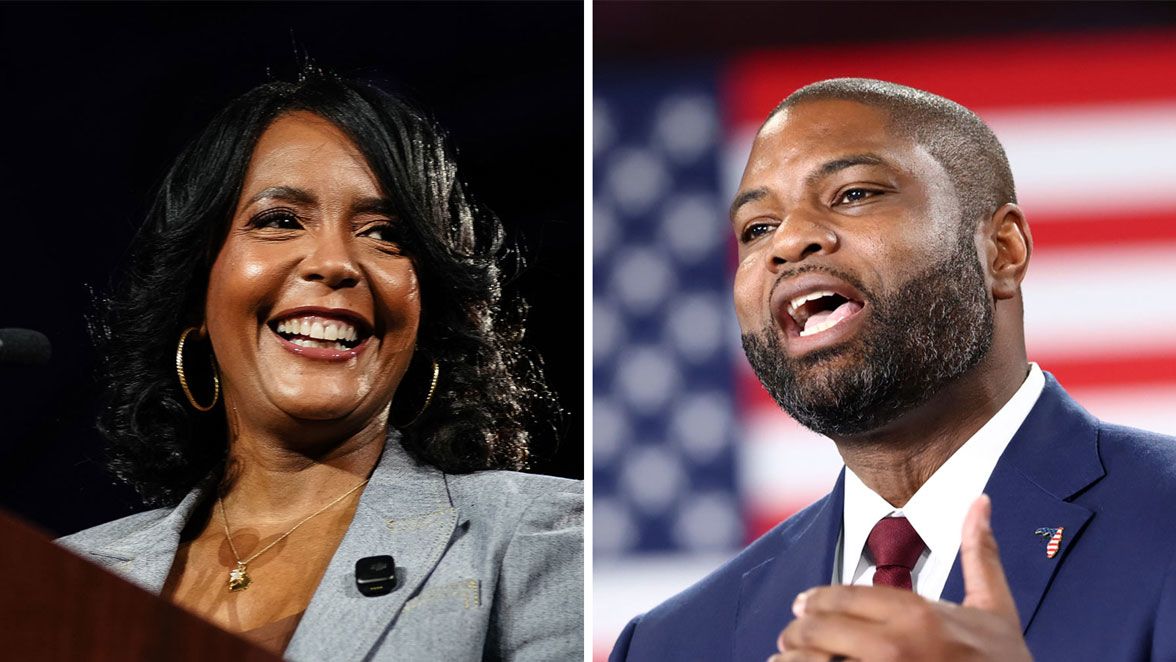
From Keisha Lance Bottoms in Georgia to Byron Donalds in Florida to David Crowley in Wisconsin, Black candidates are vying to lead eight states from the South to the Midwest to the West. In all, five Democrats are running in gubernatorial races, and three Republicans are vying to be the country’s first elected Black Republican governor.
“We’re a complicated, beautiful country,” said Bottoms, a Democrat who would become the first Black woman governor in the nation’s history if she wins. “Just because it hasn’t happened, that doesn’t mean it’s not going to happen real soon.”
Donalds, a Republican, said in a recent Fox News interview that “Black voters need to take a look at these elections and the policies that are gonna improve their lives, and more and more, you’ll find that that’s in the Republican Party.”
The eight Black nominees in governor’s races this year are seeking to force change that has been slow in coming, long after the ends of slavery and the Jim Crow era. While some carry favorable odds and others are long shots, taken together, they represent a record number of candidates in one cycle.
In 1989, Douglas Wilder became the nation’s first elected Black governor in Virginia. Deval Patrick in Massachusetts followed him in 2006. Maryland’s Wes Moore became the third elected Black governor in 2022 and is seeking reelection to a second term. (David Paterson served as governor of New York from 2008 to 2010 after being appointed to fill the term of Eliot Spitzer.)
Bottoms, 56, is the daughter of R&B singer Major Lance and Sylvia Robinson. She talks about her roots going back more than five generations in Georgia.
“For me, it’s so much more personal,” Bottoms said in an interview. “My people were once enslaved in this state.”
Still, the nominees largely have not spent much time emphasizing their potential to break through barriers in their own states — or the significance of the history-making moment if several of them win on November 3.
Nor have two history-making Democrats who have campaigned with several of them: former President Barack Obama, the first Black president, and Kamala Harris, who in addition to breaking racial barriers, was the first female vice president and in 2024 fell short of becoming the first woman elected president.
At an event Monday with Crowley, the Democratic nominee for Wisconsin governor, Harris recalled being asked by reporters to address “women’s issues.”
“I’d look at them and say, ‘I’m so glad you wanna talk about the economy,’” she said.
Still, last week in Nevada, where she campaigned alongside Democratic Attorney General Aaron Ford, who is taking on Republican Gov. Joe Lombardo, Harris touted Ford’s chance to become the first Black governor west of the Mississippi River. She told culinary workers they were “going to make history” by electing him.
Bottoms aims to ‘do something differently in Georgia’
In Georgia, Stacey Abrams twice ran for governor and fell short both times.
The disappointment Democrats had from those campaigns in 2018 and 2022 still hangs over Bottoms’ race. Yet she spends her time focused on the present, talking about how Georgia has fared in Trump’s second term.
“Everything is different with Trump 2.0,” Bottoms said. “We are now in the midst of a war that didn’t have to happen. Gas prices have gone up. Grocery prices are continuing to rise.”
Bottoms, a former Atlanta mayor, is set to appear Wednesday night at a metro Atlanta rally with Obama. The next day, Harris will also visit Georgia, underscoring the potential opportunity in a state where Democrats last elected a governor in 1998.
“I wake up as a Black woman every day, so it’s no surprise to me that I’m capable and I’m qualified and I’m able,” Bottoms said. “But if it’s representation for other people who may not have thought that it was possible, then it’s all worth it.”
She has been dramatically outspent by her GOP rival, businessman Rick Jackson, but is hoping her candidacy is lifted by the strength of Democratic Sen. Jon Ossoff, who even Republicans acknowledge is likely to cruise to reelection.
“I’ve never felt the level of anxiety and sadness that I feel when I’m talking to people across the state,” Bottoms said. “But along with that, there’s hope and there’s optimism that we can turn the corner.”
Jackson has assailed Bottoms’ record of running Atlanta, saying: “Bad mayors don’t make good governors.” Yet at a campaign stop this week in Cedartown, he acknowledged concerns of his own as he addressed supporters.
“This race is tied at best,” Jackson said. “The only reason we’ll lose is if rural Georgia doesn’t show up to vote.”
Jackson has vastly outspent Bottoms in the race, thanks in part to hundreds of millions of dollars of his personal fortune. Since the beginning of the 2026 election cycle, pro-Jackson advertising has dwarfed pro-Bottoms advertising, $271.5 million to $32.8 million, according to AdImpact data. That includes nearly $199 million from Jackson’s campaign, which has relentlessly attacked Bottoms on crime in Atlanta.
That margin has narrowed slightly since the end of the parties’ primaries but Jackson is still well ahead, with the Republican and his supporters spending $107.2 million since June 17 to $28.1 million from pro-Bottoms forces.
At a campaign field office on the west side of Atlanta on Tuesday, Bottoms acknowledged the wide spending disparity in the race but said former New York City Mayor Mike Bloomberg had just made a $2.5 million donation to help finance get-out-the-vote efforts in the final week. The Democratic Governors Association also made a late $5 million contribution, bringing its total to about $16 million.
“Tell people it ain’t over until it’s over,” Bottoms said. “What we don’t want to have happen is have this record, extraordinary turnout and then we get overtaken at the end on Election Day.”
Sue Ross, a retired city worker, was making calls alongside other campaign volunteers and thinking of the possibility of making history next week if Bottoms is victorious.
“It’s definitely the time,” Ross said. “We can take this state with our troubled history and move it into the future. This election is not just about Georgia, it’s also about America.”
Donalds seeks a GOP milestone
Republicans have nominated three Black candidates in races for governor this year: Lisa Demuth, the former state House speaker, in Minnesota; Rep. John James in Michigan; and Donalds, the Trump-aligned congressman, in Florida.
Of the three, Donalds is believed to have the best chance of winning, thanks to Florida’s more favorable recent history for Republicans.
Donalds’ campaign has operated under the assumption that his historic candidacy could help him over-perform in Black communities. Shortly after winning the nomination, Donalds announced support from a coalition of African American leaders in the state, including Gainesville City Commissioner Cynthia Chestnut, a Democrat critical of her own party’s all-White ticket.
But the racial dynamics of his candidacy have also presented challenges. It didn’t go unnoticed within Donalds’ campaign that 15 of the 16 counties Donalds lost in the August primary were in the state’s deeply conservative Panhandle, where the politics more closely resemble those of neighboring Southern states. In some places, Donalds finished third, despite carrying Trump’s endorsement.
David Jolly, the Democratic nominee for Florida governor, told CNN earlier this fall that he hopes skin color doesn’t “inform people’s vote” one way or the other, though he acknowledged some Black voters may choose to be part of history. Jolly, meanwhile, has sought to portray Donalds as out of step with Black communities on issues ranging from education to criminal justice.
Donalds’ own remarks on Black history have at times drawn backlash from both parties. In 2023, he broke with Republican Gov. Ron DeSantis over new teaching standards that called for middle schoolers to learn how some African Americans benefited from slavery, sparking a heated response from DeSantis and his allies. A year later, Donalds drew ire from Democrats after claiming at a Black outreach event in Philadelphia that “during Jim Crow, the Black family was together” and “more Black people voted conservatively.”
The tensions surrounding his candidacy were on full display during a September event at Florida A&M University, a historically Black institution in Tallahassee. Facing an auditorium of skeptical students, Donalds defended his record on immigration and the Second Amendment, as well as his support for Supreme Court rulings that weakened the Voting Rights Act and taxpayer-funded vouchers for private schools — issues that have stirred particular concern in Black communities. His remarks were met at times with groans, boos and some heated objections.
Donalds nevertheless fielded questions for several hours, remaining even after a fire alarm disrupted the event. He told CNN the next day that engaging in difficult conversations could help “bring down the temperature” and “break those walls down.”
“Every room you go into isn’t going to be a lovefest,” Donalds told CNN the next day.
The outreach, though, didn’t appear to win over many students. Myia Tucker, a student at Florida A&M, said after that while Donalds’ victory would be historic, she cares more about the policies he supports.
“Two things could be true at once,” Tucker said. “While it would be progress to elect an African American governor, I think it will also show that there are still work and policies that need to be implemented that affect us all.”
Her classmate, Desmond Whitfield, put it more bluntly.
“All skin folk ain’t kinfolk,” he said. “He may look like us, but his ideologies and his culture and what we value, he doesn’t value.”
The-CNN-Wire
™ & © 2026 Cable News Network, Inc., a Warner Bros. Discovery Company. All rights reserved.
CNN’s David Wright contributed to this report.
