The rise of legacy properties: Why families are investing in land they already own


Families face mounting pressure to consolidate wealth across generations while estate planning remains fragmented and vulnerable to legal disputes. Multigenerational living arrangements create immediate practical demands—but they also offer landowners a strategic path to preserve and compound family wealth through property improvement. The challenge: knowing which investments deliver legacy value versus those that drain capital.
This trend of property improvement isn’t reshaping the broader housing market, but it could gain influence as wealth transfers accelerate. As Triple Crown Homes, a custom home builder, explores below, statistics from Zonda and the National Association of Realtors on property improvements reveal both the legacy investment value and practical solutions for multigenerational living.
How Grandparental Wealth Compounds Across Generations
Estate planning is complex. But generational wealth compounds across time. Grandparental assets have a measurably greater impact on grandchildren’s wealth than parental assets do—a pattern that persists across decades. That’s apparent from a study that looked at almost 50 years’ worth of data, which found that a child’s relative wealth rank increases by 0.4% for every 10% jump in their parents’ wealth rank (e.g., rising from the 50th to the 60th percentile), whereas a one-decile increase in grandparental wealth corresponds to a 2.3 percentile increase in their grandchild’s adult wealth position.
Wealth transfer has more impact the farther back in the family tree it goes. This dispels the idea that social mobility is something achieved through merit alone. Based on the study findings, having grandparents who are able to pass down wealth to grandchildren is a powerful predictor of how those grandchildren will fare financially as well. Moreover, multigenerational living is becoming more common, with 25% of children sharing homes with parents and grandparents at some point.
In light of these current realities, landowners who have the means to invest in their properties have more incentive to do so. Both from an estate planning and a practical, quality-of-life perspective, adding living space to a property so that it can accommodate more people and potentially appreciate in value above and beyond market averages makes sense.
Which Property Upgrades Deliver the Highest ROI
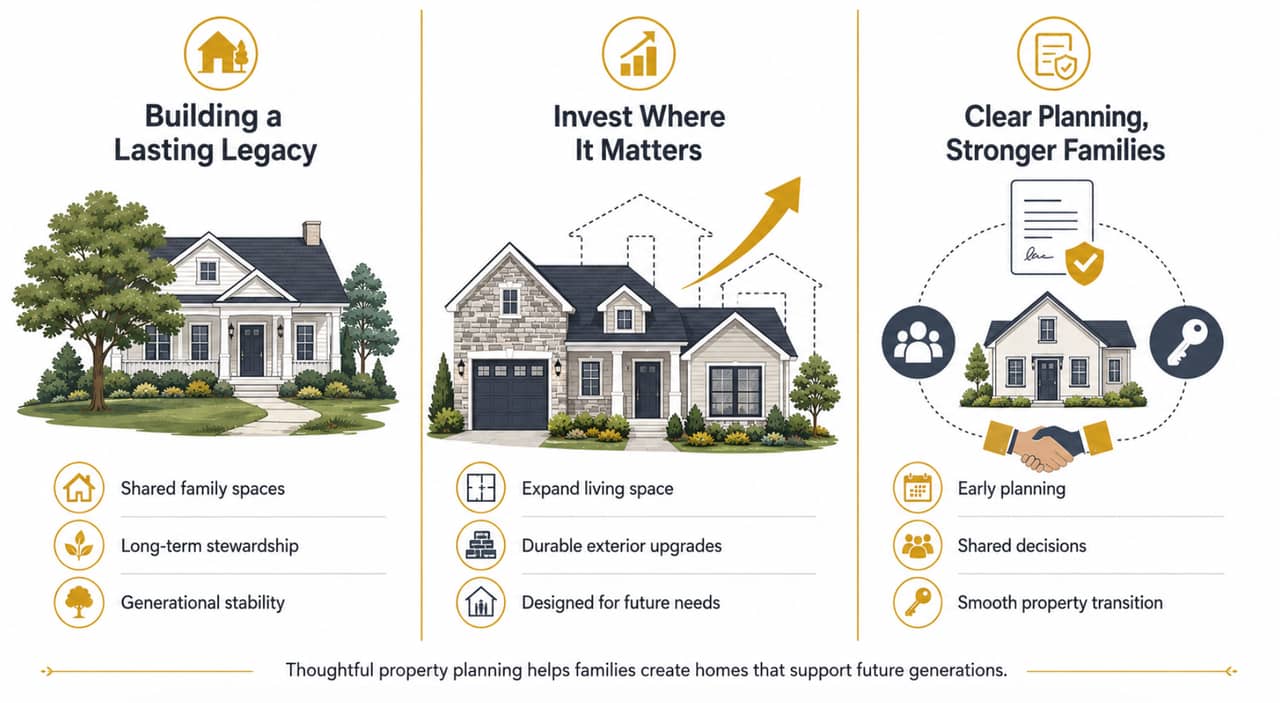
Not all property improvements deliver equal value to legacy portfolios. Exterior expansions and material upgrades outperform interior renovations in cost recovery—a critical distinction for families planning multigenerational wealth. Research from Zonda suggests that changes to the property’s exterior, both expanding the floor plan and improving the materials, deliver the best ROI, whereas interior upgrades are less likely to recoup their costs. For instance, a manufactured stone veneer has an ROI of 207.9%, while a garage door replacement is worth 267.7% of the installation price at the point of the property’s sale.
The result of expanding the living space of a home is further investigated in the National Association of Realtors’ Remodeling Impact report, with analysts applying a “joy score” of 10 out of 10 for the addition of a bedroom suite. The full report details how converting existing structural shells into livable space yields relatively high ROI, often between 75% and 86%. This may be below the ROI of simpler exterior improvements at the point of sale, but those exterior upgrades have less impact than expanding livable space in the long-term context of legacy investments.
For families starting from scratch and building a property on a blank slate, these considerations may come into the planning phase. While in the past a single-family home might have been the clearest choice, the need to combine the practicality of multigenerational living with the ROI of a property that can turn heads in years to come if it is put on the market gives landowners the incentive to design properties with multigenerational living in mind from the start.
Why Early Estate Planning Prevents Family Disputes
Analysts predict that around $105 trillion in assets will be passed from the postwar generation to their children and grandchildren between now and 2048, a fact that will undoubtedly have a huge impact on the broader economy. It also further emphasizes the importance of proper estate planning. Deferring estate planning until after death can create ownership disputes and family conflict in legacy properties.
Families who invest in land they already own should also do so with a view not only to how it will be used, but also to what exactly will happen when the older generations pass away. Early action and unified decision-making eliminate ownership disputes and establish clear succession pathways for legacy properties.
This story was produced by Triple Crown Homes and reviewed and distributed by Stacker.
