Could your drinking water cause earlier menopause?


Women with higher blood levels of several common “forever chemicals” reached menopause about a year earlier than women with lower levels, according to a 2026 study of nearly 5,000 women.
Forever chemicals, collectively called PFAS, are found in everything from tap water and nonstick cookware to some makeup, clothing, and cleaning products, and have already been linked to certain cancers and reproductive issues.
The study didn’t prove that PFAS causes menopause to happen sooner. But because forever chemicals interfere with hormonal signaling, they may affect how ovarian follicles develop and produce estrogen and progesterone. The relationship between PFAS and earlier menopause may also run partly in reverse: Menstrual bleeding helps the body eliminate certain PFAS, so blood levels can rise after periods stop.
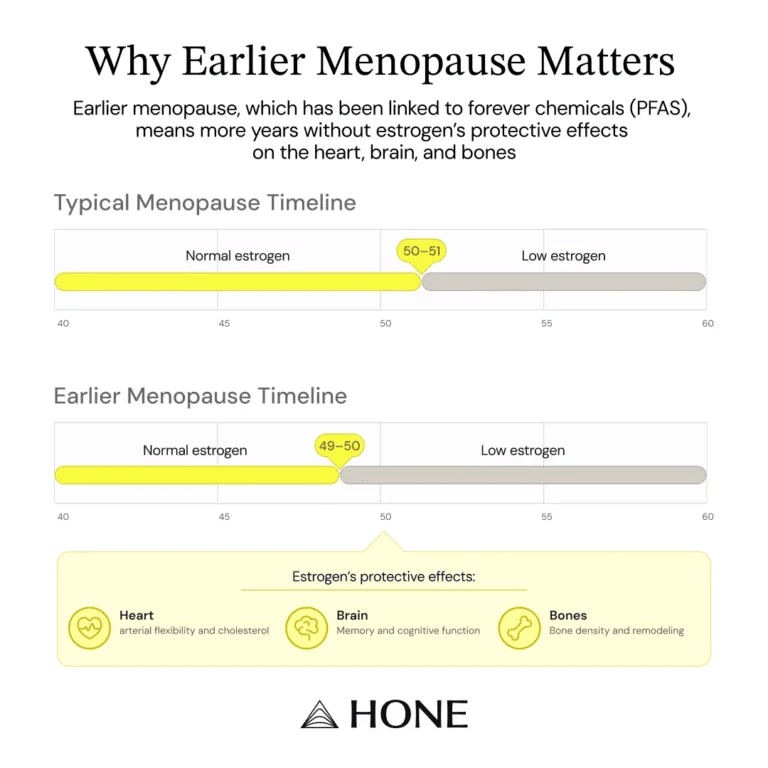
Still, the link deserves a closer look because it raises important questions about women’s long-term health, Hone Health reports. Entering menopause earlier means spending more years in a lower-estrogen state that increases risk of cardiovascular disease, cognitive decline, and osteoporosis.
PFAS exposure is independently linked to cardiovascular, cognitive, and bone problems, potentially compounding the health impact of earlier menopause.
“Entering menopause one year sooner may not sound like much, but menopause changes the hormonal environment of the entire body,” says Anastasia Jandes, M.D., a functional medicine physician and hormone management specialist. “If that shift begins sooner, changes affecting the heart, brain, and bones will begin sooner too.”
Earlier Menopause May Accelerate Aging
The drop in estrogen that occurs during menopause changes how women’s arteries function, how their bodies handle cholesterol, how quickly they lose bone, and how their brains use energy. If those changes occur a year earlier, the downstream effects could shape women’s health decades later, says Jandes.
Most women in the U.S. reach menopause around age 51 or 52. The new PFAS study examined whether this natural transition happened sooner. That’s different from early menopause, which happens before age 45, and primary ovarian insufficiency (POI), which involves loss of normal ovarian function before age 40.
But research on these younger groups helps explain why menopause timing matters. A 2026 position paper in the International Journal of Gynecology & Obstetrics is calling for POI and early menopause to be viewed not simply as reproductive conditions, but as forms of accelerated aging that can affect cardiovascular, bone, cognitive, metabolic, and sexual health.
Much of the strongest research on the long-term health risks of earlier menopause comes from women in those younger groups, so the new study can’t tell us exactly what a one-year shift means, says Jandes. “But the broader pattern suggests that menopause timing impacts health in critical ways,” she says.
Estrogen loss raises cardiovascular risk. Estrogen helps blood vessels stay flexible and influences how the body manages cholesterol. As it declines during menopause, LDL (the “bad” cholesterol) tends to rise, and blood vessels can stiffen. An analysis of 300,000 women found that those who reached menopause between 45 and 49 had a 12% higher risk of a cardiovascular event compared to those who reached it at 50 or 51. Human studies have separately found associations between PFAS and higher blood pressure, cholesterol, uric acid, and Blood Urea Nitrogen (BUN) (all of these are risk factors for heart disease or metabolic syndrome).
Earlier menopause may affect cognitive health. Early menopause is associated with greater risk of cognitive decline and dementia, including Alzheimer’s disease. That’s likely because estrogen helps regulate blood flow, energy use, and communication between brain cells, including in areas involved in memory and executive function. Animal and laboratory studies suggest certain PFAS can enter brain tissue, promote inflammation, and interfere with cell signaling, although the evidence in humans is limited.
Estrogen loss affects bones. Estrogen helps maintain the balance between the breakdown of old bone and the formation of new bone. As it declines, the cells responsible for building new bone die off faster than they’re replaced, gradually increasing the risk for osteoporosis and fractures. PFAS exposure has separately been associated with lower bone mineral density and osteoporosis in women.
How to Reduce PFAS Exposure
You can’t completely avoid PFAS, but you can meaningfully reduce exposure by focusing on the sources most relevant to where you live and work.
Find out what’s in your water. Contaminated drinking water can be the largest source in affected communities: At least 45% of U.S. tap water is believed to contain one or more PFAS. Check your local levels using the Environmental Working Group’s interactive map.
If there are high levels of PFAS in your area, install a filter with NSF/ANSI 53 or 58 certification, which means it’s certified to remove PFAS.
Consider your environmental risk. Certain working or living conditions can affect your PFAS risk:
- Living near an industrial site, airport, landfill, firefighting facility, shipyard, medical finishing facility, or data center
- Being a firefighter, military personnel who work on jets, or certain other jobs
“This is a difficult one because you may not be able to move or change jobs,” Jandes admits, “but if this affects you, pay extra attention to all the other steps you can take to avoid exposure.”
Check local fish advisories. PFAS can accumulate in freshwater fish. The EPA recommends that states monitor for 12 PFAS compounds in locally caught fish and issue consumption advisories accordingly. If your state health environmental protection department suggests your area is contaminated, limit local freshwater fish and instead choose commercially purchased seafood from grocery stores, which generally has significantly lower PFAS levels.
Replace toxic cookware. Some nonstick cookware still uses a coating containing PFAS, which can leach into food when the coating is scratched or gets overheated. Jandes says when it’s time to replace your pots and pans, choose stainless steel, cast iron, carbon steel, or PFAS-free ceramic-coated options.
Scrutinize your cosmetics and personal care products. Some waterproof mascaras, long-wear foundations, and other cosmetics add PFAS for their water- and oil-resistant properties. Check ingredient lists for terms like “fluoro” or “perfluoro” to identify them. Also, choose dental floss with natural wax rather than chemical coating (check the label for PTFE or Teflon or skip products labeled “smooth glide”), Jandes says.
If You’re Worried About PFAS Exposure
If you develop persistent cycle changes or symptoms such as hot flashes, night sweats, or vaginal dryness — particularly before age 40 — see a clinician.
Perimenopause is diagnosed mainly based on symptoms, so come prepared to describe what you’re experiencing, when those changes began, and how intense they are. Your clinician will review your menstrual history, family history, medications, and risk factors, and may also suggest blood work.
Blood work in association with perimenopause symptoms can add objective context, identify hormone patterns, and help rule out other conditions with similar symptoms.
“I’m never hesitant to check labs in a symptomatic woman in her 30s,” Jandes says. “More often than not, it’s low progesterone, changing estrogen patterns, thyroid dysfunction, or another issue rather than perimenopause. Perimenopause can begin in the late 30s, however, she adds, so if you have classic hormone-based symptoms, consider seeing a specialist to complete hormone blood work.
Blood work can show whether you’re ovulating, reveal changing estrogen or progesterone patterns, identify thyroid dysfunction or other causes of your symptoms, and provide a baseline for monitoring. It can give your doctor better information to decide whether treatment is needed and which approach fits your hormonal profile.
This story was produced by Hone Health and reviewed and distributed by Stacker.
