Corporate gatherings emerge as key driver of employee retention


Businesses looking to improve employee retention can make the mistake of attacking this problem with remuneration. The reality is that high pay won’t solve high worker turnover unless it’s combined with other strategies designed to improve engagement and build a stronger overall company culture that people actually want to be part of.
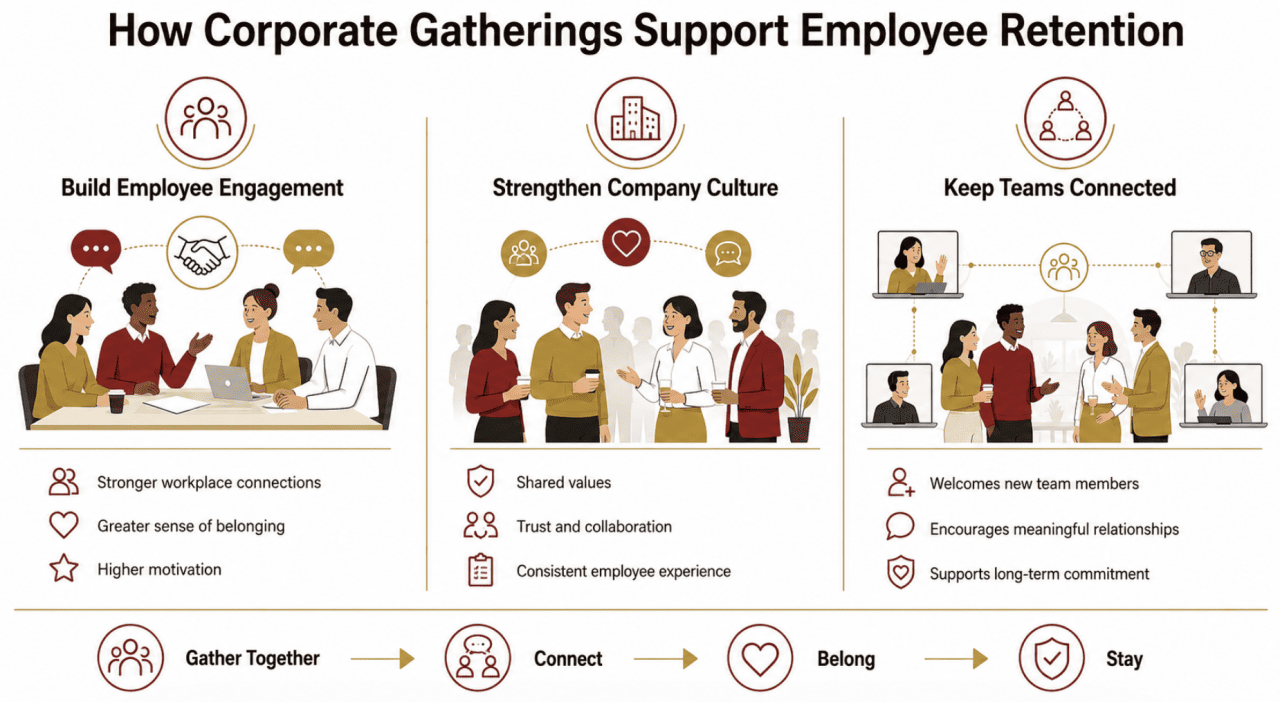
Putting together a multifaceted retention strategy means looking beyond the day-to-day employee experience. If this is already heavily optimized for engagement and job satisfaction, and there is competition for a small pool of talent in a competitive market, other perks must be explored. Parlani Party Rentals, an event rentals provider based in Los Angeles, explored how corporate gatherings can play a vital role—with well-planned, regularly scheduled events—in enabling organizations to keep team members in the fold and build a collective identity that encourages productivity and loyalty in equal measure.
Engaged Employees Perform Better
Figures compiled by Gallup from its historical research on employee engagement show that top-level profitability is 23% higher in organizations with engaged team members. Participation in the organization as a whole increases by 22% in this context, indicating that businesses with highly engaged workers can expect greater direct involvement from them beyond their basic duties.
When employees feel emotionally invested in a company, they’ll be more likely to commit to extracurricular activities like retreats and parties. Gallup’s insights find that employees who aren’t engaged will turn up if they’re obliged, but won’t be connected to what’s happening, either in the office or at an event. Those who are actively disengaged can be a disruptive force, damaging morale through overt resentment. Globally, Gallup pegs the cost of employees in these last two categories at $8.8 trillion, around 7% of the planet’s GDP.
In-Person Events Establish Company Culture
Company culture is another valuable asset that can be reinforced at corporate gatherings, resulting in an upswing in employee retention. Data from the Society for Human Resource Management (SHRM) demonstrates that 56% of employees feel their business has a good or excellent internal culture, while 21% of those who have quit a role in the past did so because of issues with in-house culture or politics.
Globally, 57% of employees who feel their current employer has a poor culture say they’re on the lookout for another job. Conversely, engaged employees who have a positive view of the internal culture are far more inclined to trust the business they work for.
The corporate gatherings companies host must align with company culture and values to have the desired effect. For instance, if a business conveys a culture of class and luxury, it is important that this is reflected in the level of prestige exhibited at company retreats. A company with a culture of cost-efficiency and frugality, or one that has gone through periods of financial uncertainty, should not spend on lavish events. Avoiding a disconnect between company culture and corporate gathering planning is crucial to reaping the full benefits in terms of employee retention.
Corporate Gatherings Combat Isolation
Even within optimized organizations, company culture can still experience erosion. The primary cause is the isolation employees feel due to the rise in remote and hybrid working arrangements.
The SHRM report cited shows that employees want flexibility as a perk from employers, typically in the form of work-from-home opportunities and adjustable working hours to accommodate family schedules. But if not everyone is in the office at the same time, day in and day out, conveying and reinforcing company culture is that much harder.
Academic research into this very issue reveals that workplace social isolation directly weakens the affective commitment, meaning the emotional attachment an employee has to their company, of newer hires. This structural detachment is one of the primary drivers of modern job-hopping and the degradation of company culture.
Likewise, workplace integration, defined as a sense of communal connectedness and a view of the organization as a true community, is heavily dependent on regular, structured social interactions that remote tools cannot easily replicate.
In-person corporate gatherings serve several purposes simultaneously. They enable a company to showcase and perpetuate its culture across entire teams. Furthermore, these events ensure new hires feel connected while allowing existing employees to refresh their understanding of business values. Businesses are heavily incentivized to follow this trend, reflecting the link between employee engagement and low team-member turnover, while profits rise.
This story was produced by Parlani Party Rentals and reviewed and distributed by Stacker.
