The wildlife refuge system is quietly falling apart


Earlier this year, supporters of Big Oaks National Wildlife Refuge—a 50,000-acre nature preserve spread across parts of three counties in southeastern Indiana—got an alarming letter from Will Meeks, the Midwest regional director of the U.S. Fish and Wildlife Service. Meeks indicated that the federal government was probably going to walk away from the Memorandum of Agreement (MOA) that has governed the refuge for more than 25 years, raising the possibility that Big Oaks, in the future, could cease to function as the public-use resource it is today.
“On April 8, 2026,” he wrote, “a meeting was held between [the] Department of the Army, Department of the Air Force, Indiana Air Guard, and U.S. Fish and Wildlife Service. … Simply stated, current realities create challenges in our ability to meet the remaining obligations in the agreement.”
Did “challenges” mean funding issues? That wasn’t explained, but it seemed possible, since the Trump administration has proposed slashing the budget for the National Wildlife Refuge system by more than $100 million for 2027, RE:PUBLIC reports. In addition, Fish and Wildlife as a whole is under a hiring freeze, so jobs lost through attrition aren’t being filled.
The letter also mentioned the loss of fire crews that worked on the refuge but “are no longer under our jurisdiction”—the implication perhaps being that this change makes it unsafe or unmanageable. (The firefighters are now part of the new U.S. Wildland Fire Service, a different branch of the U.S. Department of the Interior.) Overall, the letter’s vagueness left local advocates for Big Oaks feeling very confused.
“I am not confident that they fully understand what they do and do not have to do under the current MOA,” says Jim Leveille II, treasurer of the nonprofit Big Oaks Conservation Society—an official “friends group” that partners with Fish and Wildlife to support the facility. “It seems to me they have decided to get rid of Big Oaks as a national wildlife refuge and are fishing for reasons.”
Meanwhile, the clock started ticking, because it emerged at the same time that Meeks was likely to sign a 180-day notice of the government’s intent to withdraw from the MOA. (At press time, that hasn’t happened.) The letter was CC’d to Sabrina Chandler, an area supervisor who, like Meeks, is based in Minnesota, home to regional managers who oversee refuges in eight midwestern states. (Fish and Wildlife declined Re:Public’s request for interviews with Meeks, Chandler, and Brian R. Nesvik, the agency’s director.)
The military is involved because Big Oaks exists on an old site called the Jefferson Proving Ground (JPG), which, from 1940 to 1994, was used to test and evaluate what a 2000 planning document calls “production line acceptance munitions.” That means ammo—bombs, missiles, artillery shells, bullets—that had to pass muster before being shipped off for use. Big Oaks is what’s known as an “overlay” refuge, which means it exists on land primarily owned by a different federal agency than the one running it. There are other places in the 573-site refuge system that, while they’re not overlays, have historic ties to the military—for example, Kofa National Wildlife Refuge in Arizona, which General George S. Patton used for desert warfare training during World War II.
Testing stopped at Big Oaks in 1994; the facility was shut down fully in 1995. Fish and Wildlife started managing natural resources there in 1996, and, in 2000, an MOA with the Army and Air Force formalized a 25-year agreement to create and manage a refuge, setting aside the land for wildlife and human use but also leaving room for an Indiana Air National Guard facility called the Jefferson Range. The current MOA—the one Fish and Wildlife might abandon—was signed in 2020.
Not surprisingly, given this history, Big Oaks is home to some gnarly relics, including what the 2000 document describes as “unexploded ordnance (UXO), depleted uranium (DU), and other contaminants.” Visitors have to attend a safety briefing and sign a waiver in which they acknowledge that entering the refuge puts them at risk of “permanent, painful, disabling, and disfiguring injury or death due to the presence of expended, but still live, bombs, rockets, cannon rounds, flares, and other types of warheads. … These munitions can still explode though they may have lain in the ground for decades.”
In practice, things have gone smoothly over the past quarter-century, with no reports of exploding hikers or radioactive squirrels. Roughly 50% of the refuge is off-limits, but the remainder—including big blocks of terrain mainly used by hunters; along with a day-use area in the refuge’s northeast corner that contains a popular fishing reservoir called Old Timbers Lake—is cherished by locals. Hours are limited: At present, Big Oaks is only open on Mondays and Fridays between 7:00 a.m. and 3 p.m.
“I’ve hunted in Big Oaks since I was young,” Leveille says. “It’s a mile and a half from my house, and when I go there, I feel like I’m in a different world.”
It’s easy to see why a place like Big Oaks stands out. The federal government owns only about 1.7% of Indiana’s land, and the state is home to just three national wildlife refuges, one national forest—Hoosier, which covers nearly 205,000 acres 75 miles southwest of Big Oaks—and a small national park: 16,000-acre Indiana Dunes, on the southern shores of Lake Michigan.
If the military hadn’t established the JPG, most of Big Oaks’s 50,000 acres would, in all probability, be farmland. Instead, they’re a time capsule of what this part of the Midwest looked like in a more natural state. Even with Big Oaks’s seasonal limitations on when and where visitation is allowed, it’s estimated that between ten and twelve thousand people used the facility in 2025, for activities that include fishing, hunting, hiking, and birdwatching.
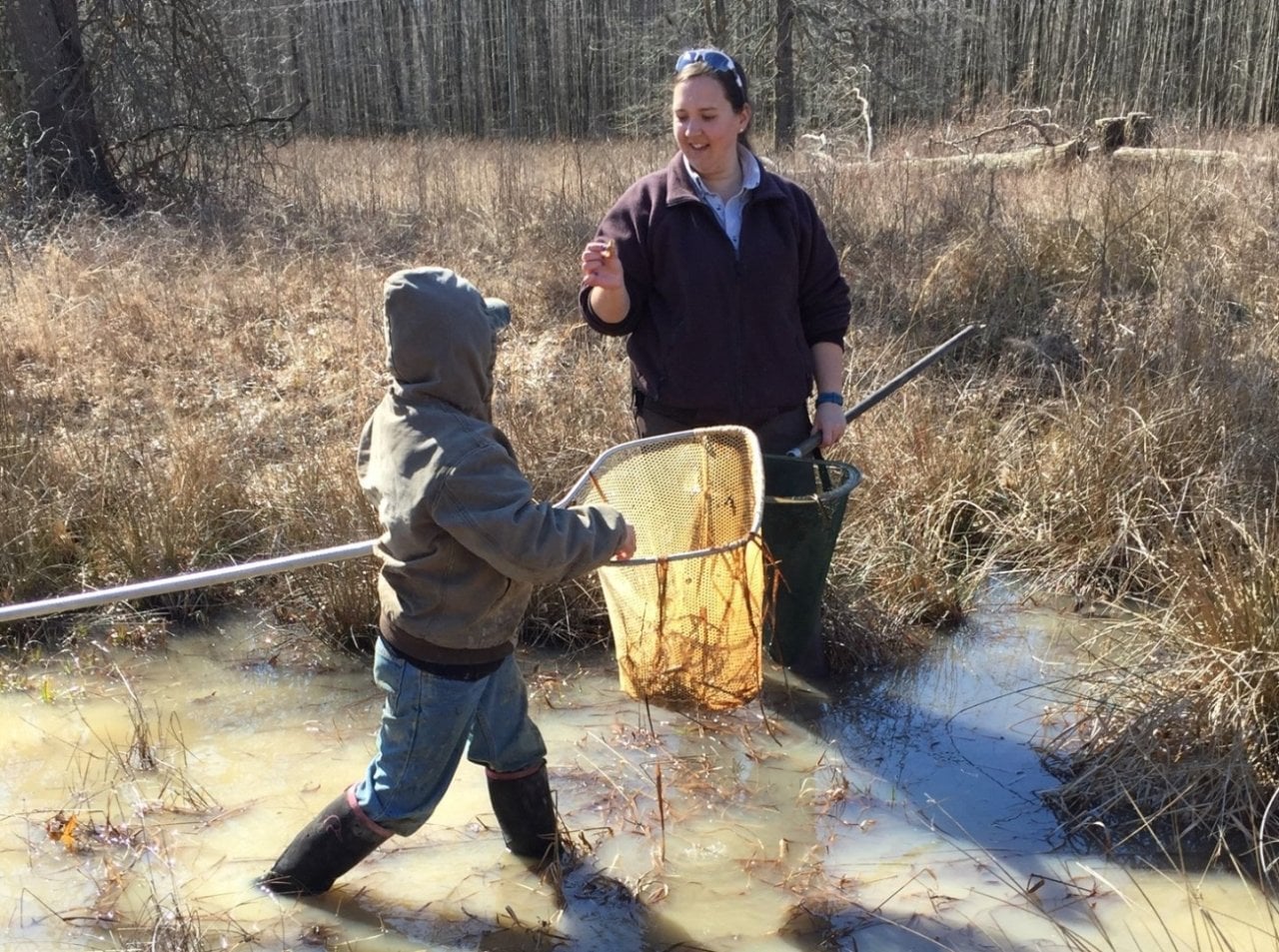
A north-south rectangle that measures roughly 16 x 5 miles and is criss-crossed by roads, the refuge features a mix of upland forests (evergreen and deciduous trees, including beautiful oaks), grasslands, wetlands, and historic structures like the Old Timbers Lodge, an American Craftsman-style building on the National Register of Historic Places. The habitat supports roughly 200 species of birds and more than 130 species of mammals, fish, reptiles, amphibians, and mollusks. The National Audubon Society recognizes Big Oaks as a Globally Important Bird Area.
For those who believe this is all worth saving, public regard for Big Oaks has been invaluable, and it has fueled what may be the best available response when faraway agents of the federal government behave mysteriously: making noise.
This has happened in various ways. Well before Meeks’s letter landed, the Big Oaks Conservation Society had been asking Fish and Wildlife for information and clarity about the refuge’s future. With his foreboding missive in hand, they pursued the obvious step of contacting local, statewide, and national elected officials.
Thorough coverage of the issue showed up in The Madison Courier—a newspaper serving the seat of one of Big Oaks’s three home counties, Jefferson—The Indianapolis Star, and on the websites of sportsmen’s outlets, such as Backcountry Hunters and Anglers and Outdoor Life. Victoria Martz, a Democratic candidate for the Indiana legislature—in a district that’s about 25 miles north of Big Oaks—organized a petition rally demanding that Congress and Fish and Wildlife “immediately restore necessary operating budget and personnel funding” to the refuge. More than 4,000 people signed it.
“Republicans, Independents, Democrats, and Libertarians all came together to demand our legislators fully fund Big Oaks,” Martz says. “Listening to speakers, it was clear the love for it crosses generations, state lines, and political parties. We have to prioritize using taxpayer dollars to preserve public lands like this and keep them open to the public.”
This outcry has had an effect. On July 8, Bob Courtney, Madison’s mayor, convened a meeting that involved several heavy hitters in Indiana politics. Among those who attended, in person or remotely, were representatives from the offices of Indiana Governor Mike Braun, U.S. Senator Jim Banks, U.S. Representative Erin Houchin, a state senator, and a state representative.
According to an account of this meeting in The Madison Courier—confirmed by people who were there—Courtney sounded determined about saving Big Oaks. “We have a good cross section of policymaker offices that in my opinion will help us get the consensus that the refuge has to stay open,” he told the group.
Chris Crabtree, state field director for Senator Banks, mentioned the ongoing mystery of why Fish and Wildlife has problems with the MOA to begin with. “We’ve heard it’s not about money,” he said. If it isn’t, he added, the discussion should be focused on “what’s it about, and proceed from there.”
On July 14, in response to a June inquiry signed by 18 environmental and conservation groups, Nesvik wrote: “We are committed to public use and access opportunities on the site. … [W]e are proceeding with deer draw hunts for the fall youth, archery and firearm hunts in conjunction with the Indiana Department of Natural Resources.”
Nesvik didn’t address the 180-day intent to withdraw, so this can be read in two ways: as the sound of a door creaking open or of a nothingburger being flipped. But it’s notable that conservationists heard from him shortly after the mayor’s meeting. If Big Oaks does survive, local support will be a big part of the reason why.
“Public lands, overall, are not always understood by politicians in the sense that there’s a group of folks who just love them,” says Joe Robb, who retired from his longtime position as Big Oaks’s refuge manager earlier this year. “A national area like this one is a different kind of beast. They’re special. They’re cherished.”
Whatever happens next, Big Oaks faces problems that have been felt for years at wildlife refuges all over the country: an erosion of funding and personnel that has occurred during both Republican and Democratic presidential administrations.
“Around 2010 or 2011, we peaked in funding,” Robb says. “In my last year or two, I was down to one maintenance person and a part-time park ranger.” When Big Oaks was fully staffed, Robb had two assistant managers, an administrative officer, two biologists, a law enforcement officer, a fire management officer, and a total of four full-time and seasonal firefighters. The fire staff helped with habitat maintenance—in part by using prescribed burns—wetland restoration, hunting management, and road work. “They were a critical part of the refuge team,” he says.
According to data compiled by the National Wildlife Refuge Association (NWRA), a nonprofit based in Washington D.C., the patterns Robb describes are widespread in the refuge system, which currently consists of properties in all 50 states and five territories.
“You can take that story and mimic it all across the United States,” Desirée Sorenson-Groves, the association’s president and CEO, says of Big Oaks. “The refuge system had already lost 30% of their staff since 2010. They were already in a place where they could barely do anything. We estimate that they’ve lost another 20%, to firing and retirements, since January 2025.”
Flat funding and the corrosive effects of inflation are a big part of the problem. In fiscal year 2010, Congress appropriated $503 million for refuges, compared to $522 million for 2026. Adjusted, that 2010 amount would be just over $730 million today. The administration’s proposal for 2027 asks for a massive cut: down to $417 million.
During this 15-year timespan, visitation to the system has increased by 55%. On the ground, what this means is a stressed system that, like Big Oaks, is getting by with a skeleton crew. “No refuges are fully staffed,” NWRA says in a fact sheet about current funding challenges. “Many refuges are closed to the public and are completely unmanaged.” At others, basic amenities like closed visitor centers, closed bathrooms, and unmaintained trails leave “a feeling of disrepair.”
This story was produced by RE:PUBLIC and reviewed and distributed by Stacker.
