Why the US has become a political base for Brazil’s Bolsonaro allies

By Alessandra Freitas, CNN
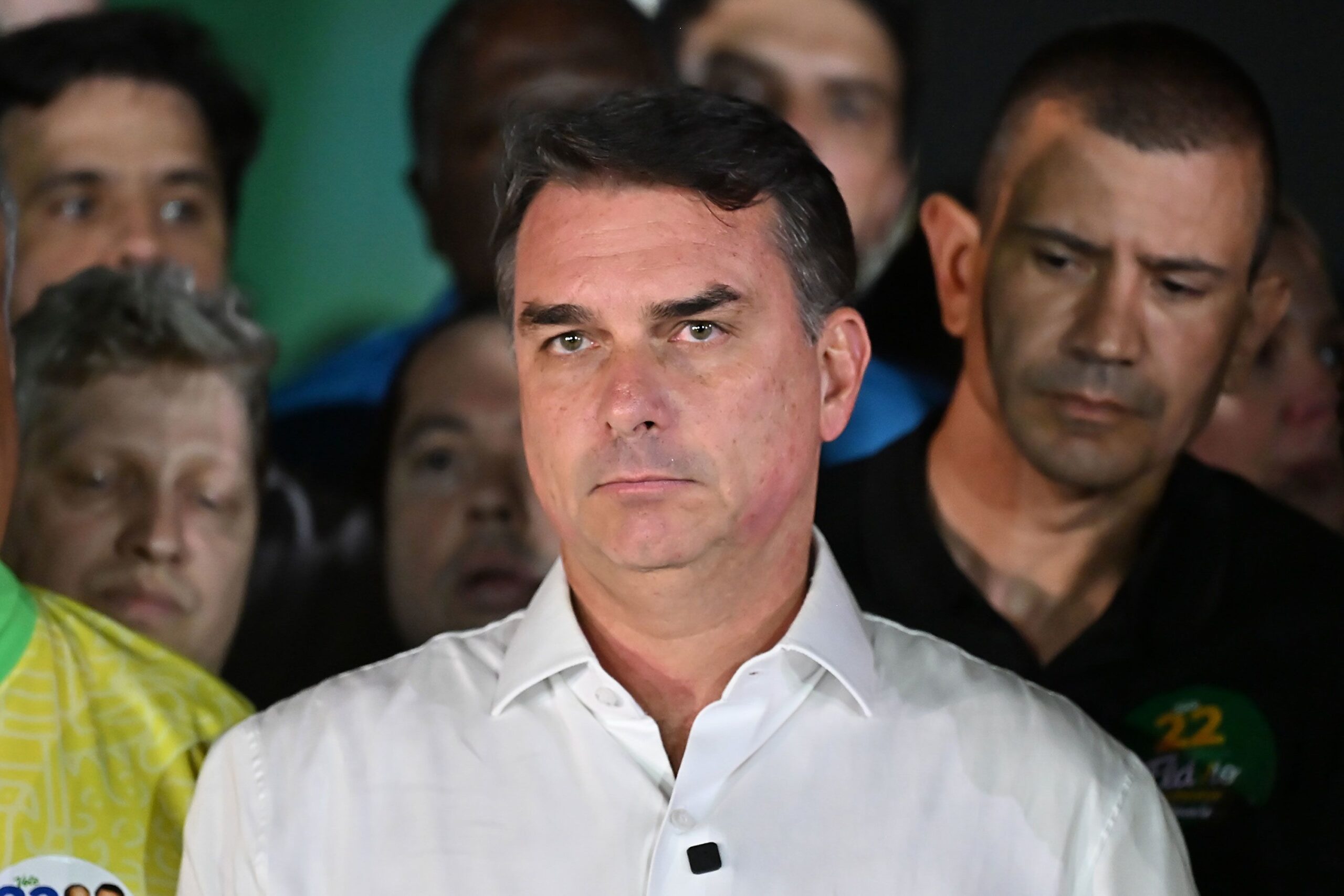
(CNN) — Three days after losing Brazil’s presidential election on Sunday, Senator Flávio Bolsonaro arrived in Miami, joining other prominent allies of the Bolsonaro political movement who have sought refuge in the United States while facing legal troubles back home.
The defeated candidate reportedly crossed into Argentina with his wife and two daughters on Tuesday, then boarded a private plane that stopped in Ecuador before landing in South Florida. He left after a Supreme Court order, issued the day after the election, required him to surrender his passports and barred him from leaving Brazil. Justice Alexandre de Moraes, who has a long history of legal battles with the Bolsonaro family, issued the order citing a “concrete risk” that the senator would flee.
On Friday, on the American conservative podcast Louder with Crowder, his brother Eduardo Bolsonaro had suggested that Flávio should leave Brazil if he lost to President Luiz Inácio Lula da Silva, citing concerns about the investigations he could face once his Senate term ends.
In a video posted Monday, Flávio Bolsonaro addressed his brother’s comments and promised to comply with the Supreme Court order, citing political persecution. His Senate term ends on January 31, 2027, leaving him out of elected office for the first time in 24 years.
Flávio Bolsonaro is currently under investigation by the country’s highest court for alleged acts of corruption and money laundering.
Upon arriving in the US, he released a three-page statement on Wednesday, declaring himself the “leader of Brazil,” despite losing Sunday’s runoff to Lula. He repeated unsubstantiated claims of electoral fraud, said it had not been his intention to leave the country and vowed to lead the Brazilian opposition from the United States.
“I want to make it clear: I did not flee Brazil. I left for Brazil,” he wrote, describing himself as a victim of political persecution and thanking US President Donald Trump and Argentine President Javier Milei for their support in his departure plans.
A growing political base abroad
In the United States, Flávio Bolsonaro joins a growing list of prominent figures in the Bolsonaro movement who have relocated there while facing legal trouble in Brazil.
Eduardo, a former congressman, moved to the US in early 2025, saying he was the target of political persecution, and received permanent residency in July. Brazil’s Supreme Court has since sentenced him to four years and two months in prison for coercion, finding that he lobbied US officials to pressure the judges overseeing his father’s coup case. Moraes ordered his arrest this month.
Former intelligence chief and congressman Alexandre Ramagem slipped out of Brazil through Guyana in September 2025, while the Supreme Court was still trying him for his role in the plot to overturn the 2022 election, and arrived in the US the day he was convicted. US immigration authorities detained him in Florida in April and released him two days later. His allies say he has applied for asylum.
Conservative commentators Allan dos Santos and Paulo Figueiredo have also built platforms in the US while facing legal disputes in Brazil.
Their cases differ, but together they suggest that the US has become more than a refuge for Bolsonaro allies. It is also a political base, with ideological allies, access to influential conservatives and a network of Brazilian supporters.
“Exile is no longer isolation,” said Teresa Cristina Schneider Marques, a political scientist at PUCRS (Pontifical Catholic University of Rio Grande do Sul), who researches “Bolsonarismo” in the US. “With social media and the media, it has become a strategy for international and transnational projection.”
Why the United States?
The US is home to the largest Brazilian community abroad, with about two million people, according to estimates from Brazil’s Foreign Ministry. That community has historically leaned conservative. Brazilian voters in the US backed the right-wing candidate in the 2010, 2014, 2018 and 2022 runoffs, according to Brazilian electoral data. This year they backed Flávio Bolsonaro, who won nearly 63% of their valid votes in Sunday’s runoff.
The ties go beyond the ballot box. Connections between Brazilian conservative elites and American political figures deepened during the overlapping presidencies of Jair Bolsonaro — Flávio’s father — and Trump, whose movements share nationalist and socially conservative positions.
After Jair Bolsonaro lost the 2022 election, thousands of his supporters stormed Brazil’s Congress, Supreme Court and presidential palace on January 8, 2023, in an attack that drew comparisons to the January 6, 2021, assault on the US Capitol. As legal pressure mounted, several prominent figures in his movement left for the United States.
Since then, Marques said, the movement has worked to “domesticate the cause” on three fronts, persuading American society to adopt it as its own.
The first is Washington, where allies have sought to influence US policy toward Brazil. The second is the media: Eduardo Bolsonaro and Figueiredo, among others, have used American podcasts, conservative outlets and social media to argue that Brazil’s judiciary is persecuting the right.
The third is the Brazilian diaspora.
“The diaspora plays an important role in spreading narratives, but also in translating them,” Marques said, “not just in English, but also adapting political messages so they resonate with American audiences.”
Groups such as Yes Brasil in Florida and the Congresso Conservador Brasileiro in Massachusetts bring together supporters, Brazilian politicians and the immigrant community, and can act as intermediaries with American conservative circles.
The result is a division of labor: prominent figures gain access to institutions and influential allies, while ordinary supporters spread the message among the Americans and Brazilians around them.
The ultimate aim is to win American support and use it to pressure Brazilian institutions, a tactic scholars call the “boomerang effect” — in which political movements turn to international allies to influence decisions at home.
A powerful ally in the White House
Trump has repeatedly criticized Brazil’s judiciary over its treatment of Jair Bolsonaro, who was sentenced to more than 27 years in prison for the coup plot. That support has had concrete consequences. Last year, Trump imposed tariffs of up to 50% on Brazilian products, explicitly citing Jair Bolsonaro’s prosecution, and his administration sanctioned Brazilian judicial authorities.
More recently, a Reuters investigation published ahead of Sunday’s runoff election, described efforts by two senior State Department officials to help the Bolsonaro family return to power, including measures intended to pressure Lula’s government.
Trump has questioned the legitimacy of Brazil’s election, without providing evidence of fraud, pointing to a last-minute Supreme Court decision to extend voting by two hours, until 7 p.m., following reports of transportation problems. At a campaign rally in Texas on Tuesday, Trump also compared Brazil’s election to his longstanding allegations of electoral cheating by Democrats.
Trump confirmed Wednesday that the US allowed Flávio Bolsonaro to enter the country. “Well, I’m not going to make a comment about that, but I know that we gave him a pass to come into the country, so we’ll see,” Trump told reporters before departing for Ohio.
A Trump adviser had told CNN Tuesday that the president had approved allowing Flávio Bolsonaro into the United States, and US officials confirmed that the administration would issue visas to the senator and his family.
It is unclear what visas they received or whether Flávio Bolsonaro will seek asylum. Permission to enter does not mean someone qualifies for asylum or is shielded from extradition.
Marques argued that, for Trump, welcoming Bolsonaro allies has political value: their claims of persecution fit a narrative, shared across the global right, that portrays leftist governments as authoritarian.
Granting asylum implicitly accuses another country of persecution, she noted.
But Marques said that narrative is harder to sell about Brazil than about Venezuela or Cuba. “Lula ends up being a stone in the shoe of the global right,” she said. “Lula is respected abroad and submitted to the courts when he was jailed in 2018, which makes him hard to cast as an authoritarian.”
His reelection has also energized left-wing leaders abroad, who see his comeback victory as a possible turning point after a series of right-wing electoral gains. Spanish Prime Minister Pedro Sánchez, for instance, celebrated Lula’s win as an inspiration ahead of Spain’s November 29 election, declaring: “What happened in Brazil will happen in Spain. The comeback of global progressivism has just begun.”
Marques suggested that a current US welcome carries less weight than it once did. “It would be one thing for the Obama administration to receive someone from Brazil as persecuted. It’s another for the Donald Trump administration.”
Nor is that protection necessarily permanent; a successive US administration might take a different view of the matter than Trump does.
A risky strategy for Brazil’s right?
Flávio received nearly 60 million votes in Sunday’s runoff, a sign of the right’s continued strength, and his sudden departure caught his own party off guard.
Rogério Marinho, the senator who coordinated Flávio Bolsonaro’s campaign, said Tuesday that party leaders had not been told of his travel plans.
With Jair Bolsonaro serving his sentence under house arrest and Flávio and Eduardo abroad, some on the right are already looking to alternatives.
“I think it’s a somewhat risky move, particularly the way Flávio did it,” Marques said. She sees exile as a deliberate political strategy, but unlike Eduardo, who presented his move as a political choice, Flávio Bolsonaro left immediately after a court order restricting his travel, feeding the perception that he fled to avoid prosecution. “The way it was done raised the costs of that strategy,” she said.
The episode could give other conservative leaders an opening to distance themselves from the family, she said, though Brazil’s right has repeatedly struggled to build an identity independent of Jair Bolsonaro. “The big question now is how long the right will allow itself to remain tied to Bolsonarismo.”
She also finds the persecution narrative hard to sustain at home, since the movement’s allies won a large share of Congress this month.
Having Flávio and Eduardo in the US could strengthen the family’s international influence. But it also presents a striking paradox: the movement’s three most prominent figures are trying to shape Brazil’s political future while two face legal risks if they return to the country, and the third, Jair Bolsonaro, remains under house arrest.
Marques expects the fight to play out on the international stage. Brazil could seek Flávio Bolsonaro’s extradition, she said, setting up a prolonged dispute over whether he is a fugitive or a dissident, along the lines of the Julian Assange or Edward Snowden cases.
“Just as Bolsonarismo is trying to make this boomerang effect work with the right, the left will do the same,” she said. “Now the question is which way it will come back.”
The-CNN-Wire
™ & © 2026 Cable News Network, Inc., a Warner Bros. Discovery Company. All rights reserved.
