Yelp advertising costs: How much should you budget in 2026?


Yelp advertising costs start at $150 per month, or roughly $5 per day, though your total can include up to three components. A Yelp Ads budget covers clicks, the optional Upgrade Package runs $180 per month on its own, and management costs whatever you pay an internal team or an agency to run it.
Those published prices tell you what it costs to open a Yelp campaign, but they do not tell you what your market needs to produce enough activity for a decision.
WebFX broke down Yelp ad costs, what moves cost per click, what a realistic budget looks like when working backward from what a customer is worth, and whether you are locked in once you start.
How much does Yelp advertising cost?
Yelp ad costs start at $150 per month, and your total depends on which products you buy and how much you spend on clicks. Here is what Yelp publishes for local businesses:
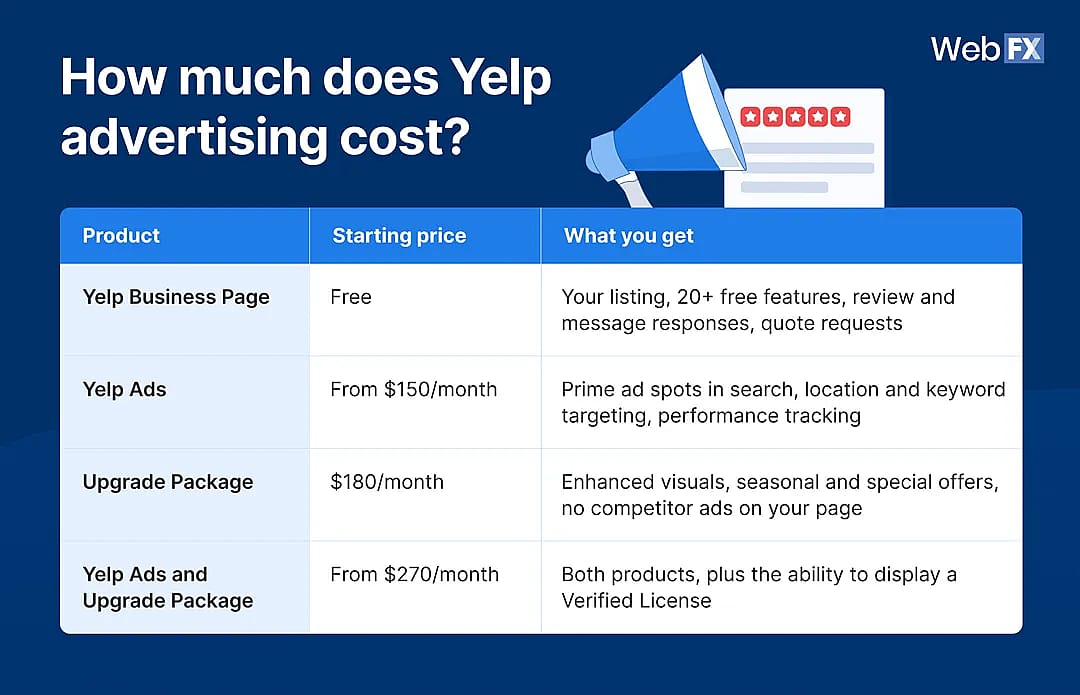
Yelp notes that minimum budgets can change, and these prices apply to self-serve local business accounts. Larger brands, multilocation advertisers, and agency-managed campaigns may operate under different pricing structures.
One thing the table makes clear is that advertising and page enhancements are separate purchases. Yelp Ads buys you placement in search results and on competitor pages, while the Upgrade Package changes how your own page looks when someone lands on it.
Why the bundle costs less than buying both
Yelp Ads at $150 plus the Upgrade Package at $180 comes to $330 per month. The bundled version starts at $270, saving you roughly $60 compared to the same two products separately.
That matters more than a discount usually would, because the two products solve different problems. Ads get people to your page, while the Upgrade Package gives them a reason to call when they arrive and keeps competitor ads off your listing while they decide.
Buying ads alone means paying for clicks that land on a page where your competitors can advertise.
How does Yelp Ads pricing work?
Yelp Ads runs on a pay-per-click advertising (PPC) model, so you pay when someone clicks your ad rather than when it appears. You set an average daily budget, Yelp converts it to a monthly maximum, and your spend cannot go past that ceiling.
Daily spend fluctuates. Some days your ads get more clicks than others, so Yelp treats your daily figure as an average instead of a hard cap. The monthly maximum is the number that actually controls what you pay.
During setup, Yelp shows an estimated cost per click and an approximate click volume for your category and targeting. Those estimates shift over time as demand and competition change in your market, and you can raise or lower your budget whenever you want.
How your monthly budget turns into clicks
Divide your monthly budget by your average cost per click, and you get the number of clicks that budget buys.
A $600 monthly budget at an average cost per click of $6 works out to about 100 clicks. If your average rises to $10, the same $600 buys about 60. These numbers illustrate the math rather than any Yelp benchmark, since your actual cost per click depends on your category and market.
That math is worth doing before making any commitments, because 60 clicks in a month is a small sample for judging anything.
Does Yelp charge per click or per lead?
Yelp charges for clicks. Calls, messages, quote requests, booked jobs, and revenue all sit downstream of the click, and none of them affect what you pay.
That gap is where most of the frustration with Yelp’s budget usually starts. Your cost per click can look reasonable while your cost per booked customer quietly fails, and Yelp’s standard dashboard tracks clicks and leads without showing whether each lead became a booked customer. Closing it takes call tracking and reporting that follows a lead from first contact through to completed work.
Can you change or cancel Yelp Ads?
Yelp lets self-serve advertisers adjust, pause, or cancel at any time, with no term contract and no cancellation penalty, and your campaign will not exceed the monthly maximum you set.
One thing to check separately: If you hire an agency, its management agreement is its own contract with its own terms. Yelp’s flexibility does not carry over to it, so read both before you sign either.
What affects your Yelp advertising costs?
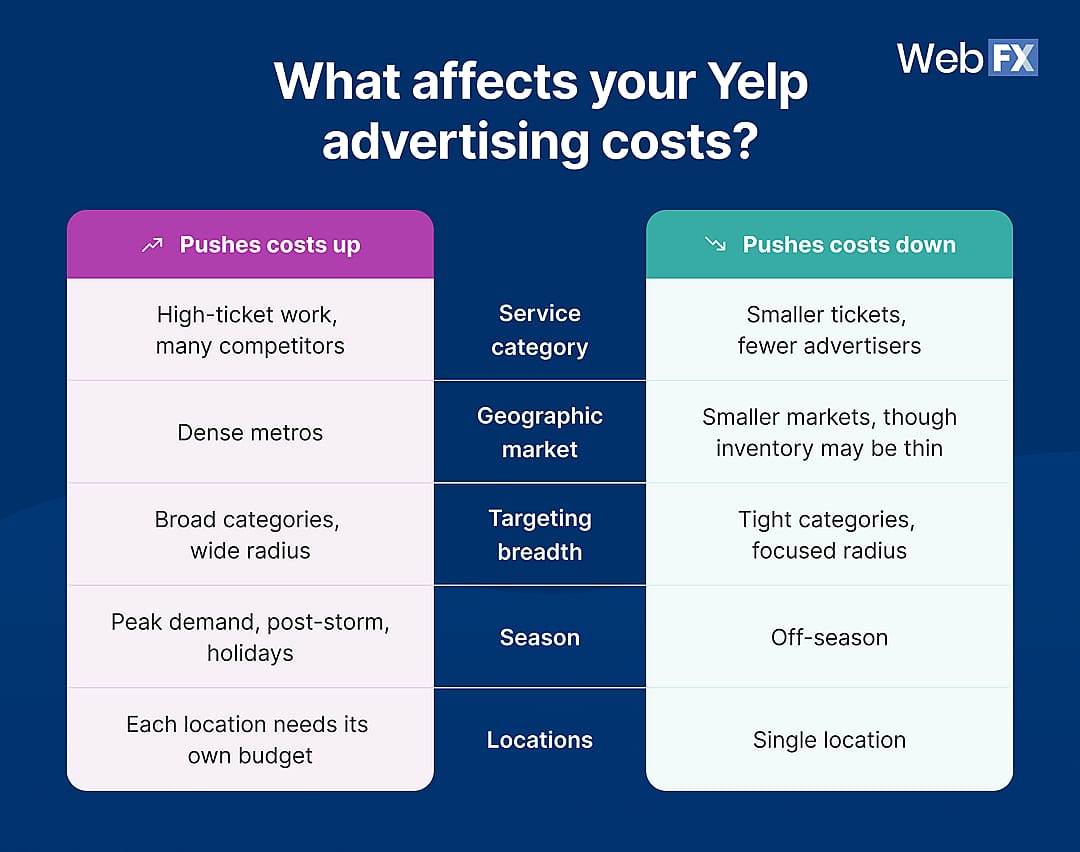
Competition in your category and location drives most of your cost per click, while your targeting, season, and the number of locations you run affect your overall spend.
Your industry and service category
Categories where a single job is worth thousands, like roofing or heating, ventilation, and air-conditioning (HVAC) installation, attract more advertisers and higher per-click costs than categories with smaller tickets. Before you blame your cost per click, check your category list, since businesses that select every category they technically qualify for end up bidding against advertisers in adjacent trades.
Your geographic market
Dense metro areas carry more advertiser competition, so the same service can cost noticeably more per click in Chicago than in a town two hours away. Small markets cut both ways, though, because a low cost per click looks good until you find there are not enough searches in your category to spend a meaningful budget.
Your targeting choices
Yelp has no match types, so your categories, blocked services, and radius do the work that keyword match types would do in Google Ads. Start tighter than feels comfortable, because adding categories later is easy, while a month of clicks from work you do not want is money you cannot get back.
Seasonality and demand
Costs move with demand, which means HVAC competition spikes during the first heat wave, roofing surges after a storm, and tax services climb near filing deadlines. Compare your costs year over year rather than month over month, since a November-to-July comparison tells you about the calendar and a November-to-last-November comparison tells you about your campaign.
Your number of locations
A business with six locations needs six budgets instead of one budget split six ways. If you cannot fund every location at a competitive level, fund fewer of them properly, because six underfunded campaigns generally produce less than two with enough budget to compete.
Why did your Yelp cost per click go up when you raised your budget?
Yelp ad costs move for several reasons, and a budget increase is not always one of them. Raising your budget does not automatically raise your cost per click, because your budget controls how much Yelp can spend on your behalf, while your cost per click reflects what the clicks available to your campaign are going for.
Advertisers do sometimes see their average climb after a budget increase, and several things can cause that at the same time:
- Competitors raised their own budgets or entered your category.
- Customer demand shifted in your market.
- Your campaign started reaching clicks that it was previously priced out of.
- Someone changed targeting, categories, or radius.
- The two periods you are comparing fell in different seasons.
- The mix of services generating your clicks has changed.
How to tell what actually changed
Before you conclude the budget caused it, line up the two periods and compare five things:
- Date range and season: Are you comparing equivalent months, or a peak month to a slow one?
- Targeting settings: Did categories, blocked services, or radius change between the periods?
- Geographic coverage: Did your service area expand?
- Click volume against average cost per click: A higher average alongside far more clicks is a different situation than a higher average at flat volume.
- Lead quality and booked work: A rising cost per click that produces better jobs is not the same problem as one that produces worse ones.
Often, the answer sits in one of the first three. If all three held steady and your average still moved, increased competition is the likeliest explanation left.
What do Yelp Ads cost per booked job?
Cost per click tells you what traffic costs. Cost per booked job tells you whether the channel works.
One HVAC company’s Yelp Ads produced paid-attributed jobs at roughly $120 in ad spend each during the first half of 2026, and Yelp Ads drove 90% of its Yelp-attributed jobs.
That reflects one client, one market, and one six-month stretch, so treat it as an example of how the math works rather than a benchmark for your category. Your own number depends on your job values, your close rate, and how quickly your team responds to leads.
What makes a figure like that usable is that someone tracked it. A dedicated call tracking number on the Yelp page, campaign-level URL tagging, and revenue attribution reporting connect each lead to the job it produced, which is the difference between knowing your cost per click and knowing your cost per customer.
How much should you spend on Yelp Ads?
Your Yelp budget should buy enough clicks to judge lead quality and booked work in your market. Yelp’s $150 minimum can support a first test, but it is not the right number for every business.
Check demand in your category and market
Look at how much search activity your category gets in your service area, how many competitors already advertise there, and how their review profiles compare to yours.
Treat that as a planning input instead of a forecast. Category breadth changes what those numbers mean, since a business listed under six categories sees different volume than one listed under two.
Use Yelp’s estimated cost per click, not an internet average
There is no reliable average cost per click for Yelp Ads, and any single figure you find online is averaging across categories and markets that have nothing to do with yours.
The estimate Yelp shows during setup is scoped to your category, your targeting, and your location. That number is worth more than any published benchmark you will find online.
Work backward from what a customer is worth
Multiply your gross profit per customer by your close rate on qualified leads, and you get the most you can afford to pay for a lead. A business earning $1,500 in gross profit per customer that closes 20% of qualified leads breaks even at $300 per lead. Aim below that, because break-even leaves nothing for overhead or profit.
Run this before you set a budget. It tells you whether Yelp needs to deliver leads at $50 or $250 for the channel to work, which is the difference between a viable test and an expensive one.
Fund a real test period
Judging a Yelp campaign after two weeks tells you about those two weeks, not about the channel. Plan on testing the platform for roughly 90 days before performance and optimization trends give you something reliable to act on.
The key is to budget accordingly, as a number you can sustain for a quarter beats a larger one you pull after five weeks.
How much does it cost to manage Yelp Ads yourself versus hiring an agency?
Managing Yelp Ads yourself costs you time instead of a fee, while hiring an agency adds a management cost on top of your ad spend, with partner insights, campaign management, and revenue attribution handled for you.
Here is what each path actually includes:
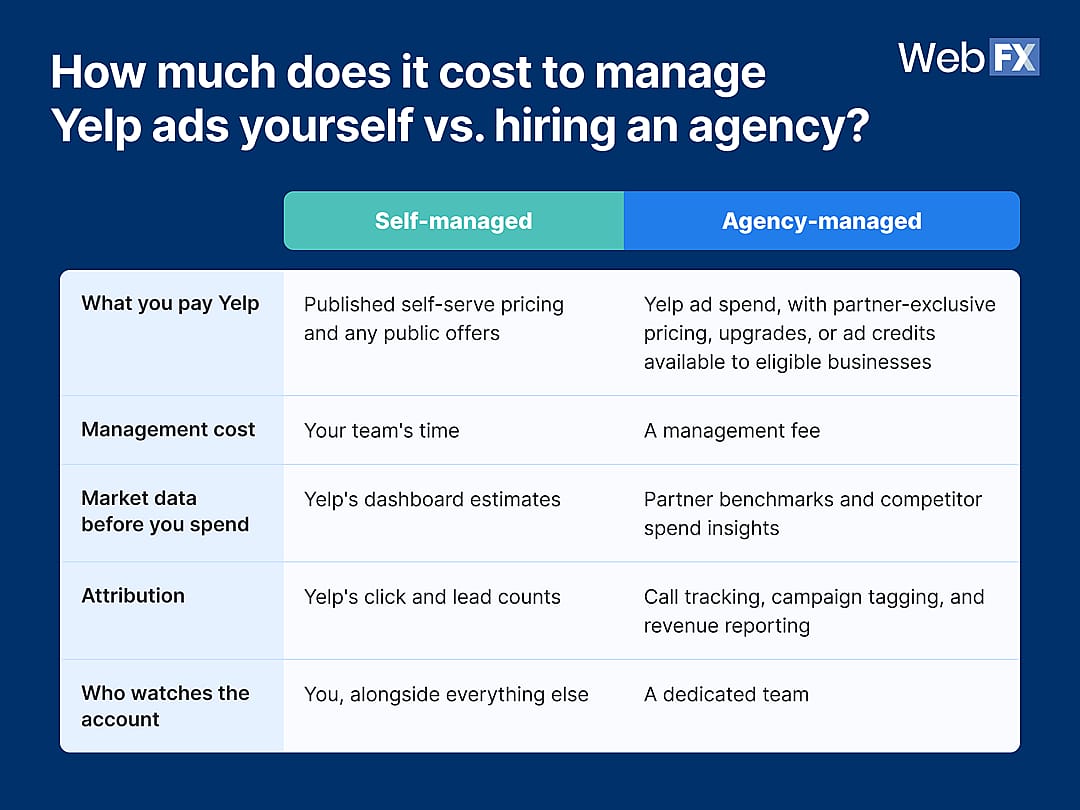
The honest trade-off is time against visibility. A self-managed campaign can work if someone on your team will genuinely check it weekly, prune categories, and follow up on every lead. Most contractors who try this discover the account gets attention in month one and then drifts.
The management fee only makes sense if it buys back more than it costs. Work out your break-even cost per lead, then ask whether better targeting and attribution would produce enough additional booked jobs to cover the difference.
This story was produced by WebFX and reviewed and distributed by Stacker.
