Socorro ISD expects to adopt balanced budget for second year in a row
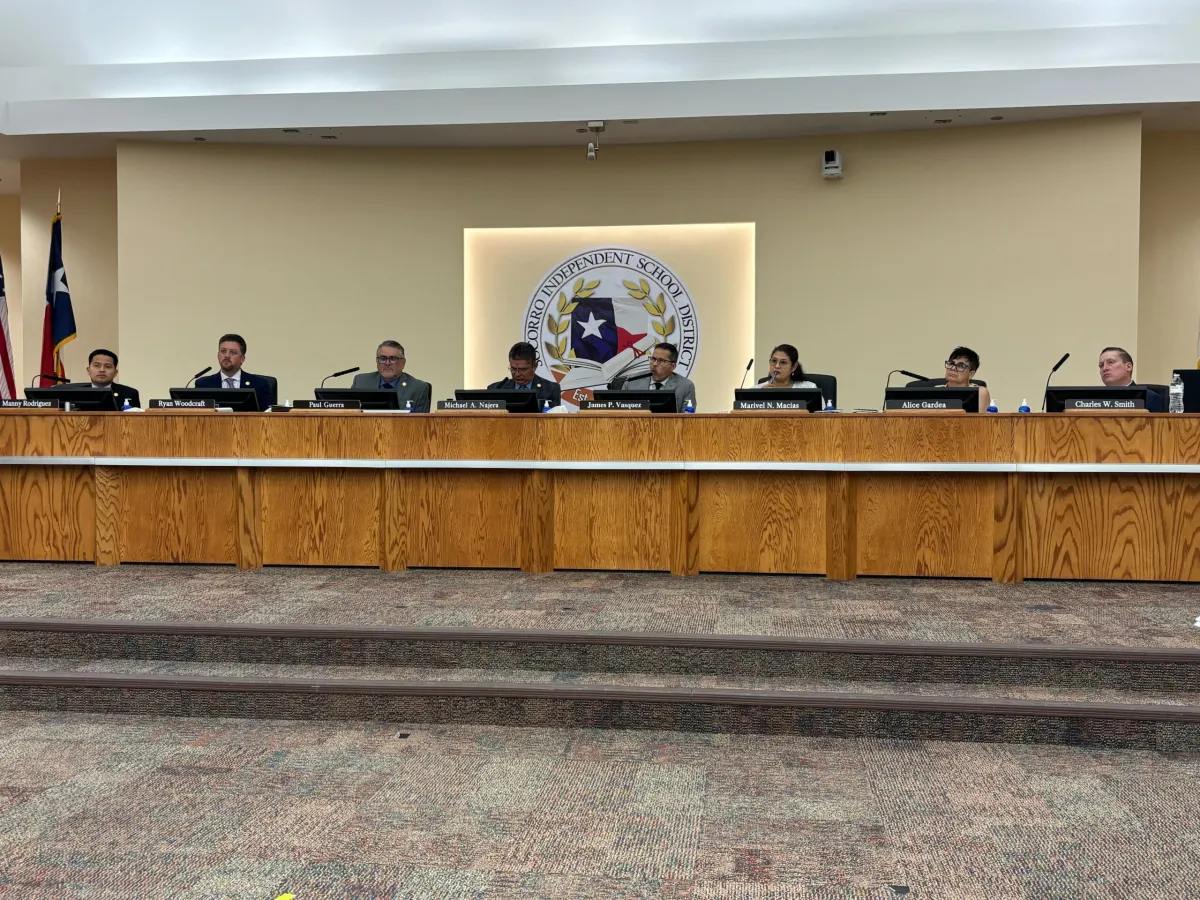

The Socorro Independent District expects to approve a balanced budget this June for the second year in a row, as it traverses a multi-year plan to rebuild its savings after nearly a decade of spending more than it generated in revenue.
The district is planning to adopt a $465.5 million budget with a $550,000 surplus that will be used to cover the costs of operating the SISD Aquatics Center, district officials said during a board meeting presentation Wednesday.
Under the plan, the district expects to adopt a $2 million surplus next year and a $3 million surplus the following year, which will go toward its unassigned fund balance.
While SISD is trying to strengthen its savings, the county’s two other largest districts, El Paso and Ysleta ISD, will need to tap into theirs just to stay afloat. El Paso ISD is considering seeking financial exigency, which would allow them to break employment contracts and other agreements.
SISD Superintendent James Vasquez said the district may end the year with a small surplus,but will not give the amount until the fiscal year closes. Vasquez said he expects to need a short-term loan for $30 million to cover payroll costs while waiting for state funding.
“We’re proud of the work that we’ve achieved to this point. We’re not ready to celebrate just yet. These issues are not confined to the region,” Vasquez said. “There’s a statewide issue with insufficient funding, and ultimately, who suffers from this the most is our students.”
SISD employees won’t get a raise next school year, beyond what was already implemented when school funding was increased during the 2025 Texas Legislature, Chief Communications Officer Daniel Escobar told El Paso Matters.
SISD Chief Financial Officer David Solis said future raises will need to be balanced with some of the district’s other needs, including replacing outdated technology, upgrading air conditioning and bus or vehicle replacements.
“All of these priorities will continue shaping not only next year’s budget but future budget discussions as the district works to balance growing needs with the limits we shared,” Solis said.
Some homeowners living within SISD’s boundaries may also see an increase in the school portion of their property tax bill as the district prepares to adopt a tax rate for 2026 and potentially call for a voter-approval tax ratification election, or VATRE, that could generate more revenue for the district.
SISD voters last year narrowly rejected a VATRE proposal that would have shifted a portion of the tax rate used to pay its debt to pay for operations, totaling $49.2 million in revenue.
Based on preliminary property values and anticipated compression, the district expects to adopt a property tax rate of $0.91 per $100 of valuation, which would cost about $930 for the median home worth $241,600. A possible VATRE is not included in this rate, district officials told El Paso Matters.
Last year, the district adopted a tax rate of $0.93 per $100 valuation, costing $870 for the median valued home worth $232,700.
Building savings amid declining enrollment
SISD plans to hold a public hearing and adopt a budget June 17. The district will receive certified property values in July, allowing it to finalize its tax rate calculations. The district has until Aug. 17 to call for a VATRE.
In late 2024, SISD officials were worried they had nearly depleted their savings, forcing them to take out loans to cover payroll.
Now, the district plans to start rebuilding its reserves next year, even as demographic researchers expect enrollment to decline in the coming years.
At the time, officials worried their savings would drop to $22.1 million at the end of the 2025 fiscal year, or enough to operate for 17 days in an emergency.
SISD officials said Wednesday the district now has enough funds in its savings to operate for 29 days in an emergency, or $37.1 million.
SISD policy requires the district to have enough to keep the district afloat for 75 days. Texas school districts also need to have enough to keep running for at least 75 days to get an A in the Financial Integrity Rating System of Texas.
The district expects to have 800 fewer students next school year and will be down 3,600 students by 2036, according to a presentation from Zonda, a demographer hired by the district.
Zonda adviser Paul Cash said the district may lose students at a faster rate depending on how the state’s new voucher-like program that allows families to send students to private schools using state funds affects enrollment, and if high interest rates deter residents from buying homes in the district.
“I will say that, as we do more and more of these reports, we learn more about vouchers and the state of education in Texas, this is probably the middle forecast. And if interest rates don’t help, something slightly lower would probably be the more practical forecasts at this time,” Cash said.
Vasquez said the district has already cut about 29% of its central office administrative staff over the last two years, while campus staff was reduced by about 9% to save money. He did not say how much this saved the district.
Even with the loss of students, the district still plans to have a $2 million surplus next year and a $3 million surplus the following year, taking it to 33 days by 2028.
EPISD is expected to end the year with a $52.8 million deficit and a $42 million deficit for the 2026-27 school year, which will reduce its savings from $101 million to $18 million or enough for 12 days if the district doesn’t take drastic measures, which could include layoffs.
YISD expects to end the school year with about $13 million in its savings.
