El Paso, West Texas federal courts deluged with challenges to immigration detention

by Robert Moore, February 1, 2026
Eighteen-year-old Heidy was stopped by immigration agents on Jan. 14 as she drove to community college classes in a Minneapolis suburb. An immigrant who came from Ecuador when she was 11, Heidy tried to explain that she and her mother had been granted the right to live and work in the United States under a program that protects victims of violence.
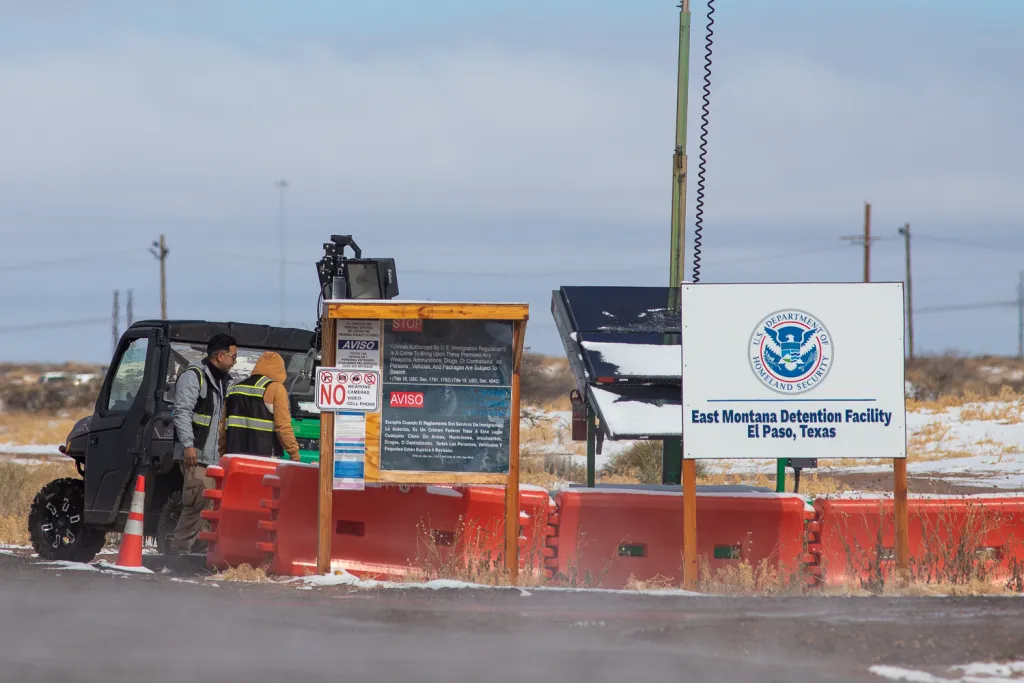
The immigration officer refused to look at her documents, told her “it didn’t matter; you aren’t legal,” and had Heidy flown the same day to El Paso, her lawyers said in a Jan. 20 court filing that sought her release through a process called habeas corpus. The lawyers said she was “abducted by ICE agents in Minnesota” and transferred to Camp East Montana on Fort Bliss, the largest Immigration and Customs Enforcement detention facility in the country.
Within hours of the petition being filed, U.S. District Judge Kathleen Cardone of El Paso ordered the government to show cause why Heidy shouldn’t be freed. El Paso Matters is identifying Heidy only by her first name to protect her privacy.
The U.S. Attorney’s Office for the Western District of Texas made no effort to defend the legality of Heidy’s detention, instead telling Cardone that she had been freed Jan. 22. Heidy’s lawyers said her family had to pay for her return to Minnesota.
Since the Trump administration began its mass deportation efforts in early 2025, more than 1,300 immigrants detained by ICE have filed legal motions known as habeas corpus petitions in the federal court system’s Western District of Texas, an area stretching from El Paso to Austin that is home to numerous ICE detention facilities.
The district received 759 federal habeas corpus petitions in 2025, more than any previous year. That record for a year was broken in the first month of 2026, an El Paso Matters analysis of court records found.
Habeas corpus – Latin for “you have the body” – is a centuries-old legal doctrine enshrined in the U.S. Constitution that allows incarcerated people to challenge their detention before a judge.
Many of the immigration detainees filing habeas corpus petitions in El Paso and elsewhere in the Western District of Texas have succeeded in being granted bond hearings, or their outright release, although the exact numbers are difficult to determine. While federal court records generally are available to the public through an online system, most filings in habeas corpus cases can only be viewed by the public in El Paso at a single computer in the federal courthouse.
The vast majority of the habeas petitions filed in the Western District of Texas since President Donald Trump’s second inauguration allege that an immigrant is being held illegally. Some of the cases have shown that people were held despite their lawful status in the United States. Some involved Trump’s efforts to invoke a 1798 wartime power to deport “enemy aliens.” At least one involved a person illegally deported, who was ordered returned to the United States.
Most of the petitions say the detainee has been unlawfully denied his or her right to seek a bond to get released from immigration detention.
The filings have increased at an unprecedented rate in recent weeks, including in El Paso. Federal judges, prosecutors and detainee attorneys are swamped.
“I can tell you that the U.S. Attorney’s Office is just utterly underwater, to the point that I now have a case in which they blew a deadline. And, so, I had to file a motion to the court saying, ‘Well, you gave them a deadline to respond. They didn’t respond. Please release my client.’ That’s unheard of for the Department of Justice to just miss deadlines because they’re so underwater,” said Simon Sandoval-Moshenberg, a Virginia-based attorney who has handled a number of high-profile cases across the country, including that of Kilmar Ábrego García, the Maryland man unlawfully deported to El Salvador in 2025.
The U.S. Attorney’s Office for the Western District of Texas didn’t respond to a request for comment from El Paso Matters. Alia Moses, the chief judge for the Western District of Texas, said she couldn’t comment beyond acknowledging that courts in Austin, San Antonio and El Paso were seeing large numbers of habeas corpus petitions.
From 2021 to 2024, judges in El Paso handled an average of 26 federal habeas petitions a year. In 2025, that jumped to nearly 300. In January 2026, federal habeas filings in El Paso came in at a pace that, if continued, would yield more than 2,800 such filings this year.
All but a handful of the Western District of Texas filings in 2025 and 2026 are from people in immigration detention, while petitions in prior years came primarily from federal prison inmates.
Why habeas corpus filings are exploding
In his 2024 campaign, Trump promised to unleash a mass deportation effort if elected. He has followed through with numerous policies to remove people unlawfully present in the United States. At times, those efforts have rounded up people who are legally in the country.
As a result, a record 73,000 people were in immigrant detention nationwide as of mid-January, including thousands in El Paso.
Much of the surge in habeas corpus filings is due to the Trump administration declaring last year that undocumented immigrants apprehended in the country’s interior were not eligible for bond while in detention, a reversal of decades of legal precedent. The decision came as the Trump administration geared up its mass deportation efforts.
More than 300 district court judges have ruled that the Trump administration is violating federal law with its no-bond policy, while only 14 have supported the new interpretation, according to a Politico report. The Fifth Circuit Court of Appeals in New Orleans will hear oral arguments on the issue Tuesday. The determination of who is eligible for an immigration detention bond could eventually be made by the Supreme Court, but likely not before next year.

The Camp East Montana migrant detention facility, shown Jan. 25, holds thousands of detainees from across the country. (Corrie Boudreaux/El Paso Matters)
A 2022 Supreme Court ruling also is a major factor in the rise of habeas corpus petitions from immigration detention, said Sandoval-Moshenberg, one of the nation’s leading experts in immigration law. That decision barred the use of class-action lawsuits in immigration detention cases.
“This is the kind of thing that, prior to the (2022 Supreme Court) decision, would have been knocked out with a single nationwide class action. It’s so blatantly illegal,” he said of the Trump administration policy denying bond in most immigration detention cases. “There’s this massive consensus among federal judges that this is blatantly illegal.”
“Our side sort of warned the Supreme Court, if you rule this way, you’re dooming the federal courts to an onslaught of individual habeas cases. And we were right, and this is now the result of it. Every single person has to file their own lawsuit to challenge the same policy, instead of there just being a single class action challenging the policy,” Sandoval-Moshenberg said.
Minnesota cases
A large portion of the habeas corpus petitions going before El Paso judges in recent weeks have involved immigration detainees brought from Minnesota to Camp East Montana, ICE’s largest detention facility that currently holds 3,000 people, an El Paso Matters review of court records showed.
Many of those detainees were moved from Minnesota to El Paso on the same day they were detained in the Trump administration’s massive crackdown that has spawned massive protests, leading to the killings of two American citizens by federal agents in Minneapolis.
The rapid movement of detainees from Minnesota to Texas is a deliberate effort to make it more difficult for them to seek relief through habeas corpus, said Brendan McBride, an attorney in Anoka, Minnesota, who is representing six clients on habeas corpus petitions filed in El Paso and San Antonio since the beginning of the year. Heidy, the community college student, was one of those clients.
McBride moved to Minnesota in 2019 from San Antonio, and has maintained his admission to practice law in the Western District of Texas.
“When you file a petition for a writ of habeas corpus, it has to be filed in the federal district court that encompasses the geographic area where the petitioner is currently being held by the government. And that means that in order to file a petition for a writ of habeas corpus, the lawyer that’s filing it for you has to be admitted to practice already in that particular federal district court,” McBride said.

A masked U.S. Immigration and Customs Enforcement agent knocks on the window of a vehicle driven by an observer looking to disrupt ICE raids in Minnesota on Jan. 12, 2026. (Photo by Nicole Neri/Minnesota Reformer)
Moving detainees also takes them away from their immigration attorneys, who are most familiar with their clients’ legal issues, he said.
“And in order to prevent their lawyers who are working for them in the immigration system from representing them, the lawyers who know the most about the situation and have the direct relationship with them, they’re whisked away to a different district where those lawyers aren’t admitted to practice. They have to find someone in the district where the detainees have been moved to file the habeas petition for them.”
Finding another lawyer, in an area where a detainee’s family has no contacts, can be time consuming and expensive, Sandoval-Moshenberg said. And that can carry serious consequences.
“It means that people who don’t have the financial resources end up giving up their cases and accepting deportation,” he said. “In cases in which the habeas corpus litigation, for whatever reason, is taking a long time, it means that the person might not get access to a bond hearing before their immigration case is decided. Immigration cases for people in detention take place at a lightning-fast pace. And so it’s a bit of a race against time.”
And with record numbers of people now held in immigration detention, there aren’t enough lawyers to handle all the potential claims of unlawful incarceration, McBride and Sandoval-Moshenberg said.
McBride is an appellate attorney who had no experience in criminal or immigration law before he began handling habeas corpus petitions for detained immigrants in January.
“I’ve told a lot of friends that in the last two weeks I’ve become an accidental immigration lawyer,” he said.

In Minnesota, volunteers are helping families file their own habeas corpus petitions for loved ones in immigration detention, McBride said.
“There’s been a massive outpouring of mutual aid and coordinated efforts to help people here. And one of those things has included a lot of people volunteering to help families navigate the process to file their own when it (costs) too much, or because there’s too many for the few lawyers that can do it,” he said.
Court records show that multiple people seeking habeas corpus relief without an attorney, known in legal parlance as filing pro se, have won their cases before El Paso judges in recent weeks. But pro se filings add to the challenges of detainees.
“If they’re filing pro se habeas corpus petitions without a lawyer, they don’t have (online court) accounts, those are probably being mailed. So, that’s another level of delay,” McBride said.
How El Paso federal judges are responding
Because habeas corpus petitions involve a person’s freedom and at times their safety, federal law makes them a priority for judges. When a petition is filed, a judge gives the government an order to “show cause” why the petitioner should continue to be detained. The petitioner has a chance to respond to the government’s filing, and the judge generally decides whether to grant the petition within a few weeks of when it was filed.
El Paso has four federal judges with lifetime appointments, all of whom are handling habeas corpus petitions.
David Briones, who was appointed to the bench by President Bill Clinton in 1994, and David Guaderrama, appointed by President Barack Obama in 2012, have senior status, a form of semi-retirement that allows them to reduce their workload while retaining their full salary and staff.
El Paso has two district judges handling full caseloads, and who have been assigned most of the habeas corpus petitions. Kathleen Cardone was appointed by President George W. Bush in 2003, and Leon Schydlower was appointed by President Joe Biden in 2024.
An El Paso Matters review of habeas petitions show that Cardone, Briones and Guaderrama generally give the government a short window to respond to the show cause order, from two to seven days. Their show cause orders to the government often mention that the petition seems to include claims similar to prior cases where Western District of Texas courts have granted relief sought by a detainee.
In their show cause orders to the government, Cardone and Briones often mention that the petition includes claims similar to prior cases where Western District of Texas courts have granted relief sought by a detainee.
“As alleged, (his or) her case appears materially indistinguishable from several others in which this Court has found a procedural due process violation,” Cardone has written in numerous show cause orders for the government.
Briones routinely chides the government for prior actions on immigration cases. He and Guaderrama regularly issue temporary restraining orders that bar the government from moving or deporting detainees while their habeas corpus petitions are pending.
“Due to prior incidences in this Court of Respondents or their assigns removing petitioners from the United States and/or jurisdiction of the Western District of Texas – El Paso Division even after the Court orders them not to do so, this Court, in its discretion, finds good cause to issue a temporary restraining order restraining Respondents from removing Petitioner from its jurisdiction or the United States until further order of the Court,” Briones writes in show cause orders.
Schydlower, the newest El Paso judge on the federal bench, takes a notably different approach from his three colleagues in handling habeas cases. He gives the government far more time to respond to show cause orders – often three weeks.

The Albert Armendariz Sr. United States Courthouse in Downtown El Paso, Dec. 15, 2025. (Robert Moore/El Paso Matters)
One result is that habeas petitions before Schydlower are decided much more slowly than with the other judges, if at all.
For example, Cardone was assigned 49 habeas petitions in December 2025, and 36 of those cases were closed by the end of January. She ordered the government to provide bond hearings in 35 of the cases, and immigration judges approved bonds for 33 of those people. One person was deported before Cardone could rule on the habeas corpus petition.
Schydlower was assigned 43 habeas petitions in December 2025, and only five were closed by the end of January. In four of the closed cases, the petitioner was deported while the habeas corpus case was pending before Schydlower; the fifth case was not an immigration case and involved an inmate in a federal prison.
Several attorneys who regularly handle habeas corpus cases in the Western District of Texas told El Paso Matters they can’t understand why Schydlower is taking a much slower approach on such cases than his El Paso colleagues. The attorneys asked not to be identified so they didn’t put their clients at risk by being seen as criticizing a judge.
“Justice deferred is really justice denied, because clients give up, they give up hope. When they’re in illegal detention for three or four months or six months, they suffer there,” one attorney said. “People lose hope when they have to be stuck in that for a long period of time and have no idea when they can leave, and frankly, why they’re there.”

Federal judges cannot comment publicly about pending cases, and Shydlower and other El Paso judges didn’t respond to requests for comment from El Paso Matters about the impact of the growing number of habeas corpus petitions.
However, Schydlower had his judicial assistant provide El Paso Matters with a notice he issued on his pending cases Thursday. The notice suggested he won’t rule on those cases until the Fifth Circuit Court of Appeals rules on the bond issue.
“This is one of 134 habeas corpus cases pending in this Court in which the petitioners seek relief, in whole or in part, under (federal habeas corpus law). The Court now receives between 20 to 25 new such cases each week, and yesterday the Court received 6 new cases,” Schydlower wrote.
He told out-of-town lawyers to be prepared to travel to El Paso on short notice for hearings after the appeals court rules.
The other three El Paso judges continue to move forward with habeas corpus petitions in their courts, including issuing orders Friday for the government to provide bond hearings for detainees.
After Heidy was released, McBride and his co-counsel, Terja Kristina Bouvin Larsen, made one final plea in a Jan. 28 court filing to Cardone.
“The other relief Petitioner requests of the Court – and anyone else who still believes in the importance of the rule of law – is that the justice system deals with the aftermath of a campaign of terror and cruelty that has unnecessarily wasted an enormous amount of public resources, including the time and effort of the court and its staff, and that the Court simply remember Heidy.”
