A day out in the Death Strip: How a symbol of communist paranoia became a wild paradise

By Marcel Krueger, CNN
Cheiner Torfmoor, Germany (CNN) — Germany’s most peaceful landscape owes its existence to one of its most paranoid.
The Grünes Band — the Green Belt threading 860 miles along the former border between West Germany and communist East Germany — is now a sweep of orchids, wetlands and bird-rich moorland.
It began life as a fortified no-man’s land, wired with mines and patrolled day and night to keep citizens in the East from escaping.
Walk it today, and the Cold War feels impossibly far away. There’s birdsong, frogs and a boardwalk over the Cheiner Torfmoor’s marsh orchids.
But the quiet is only possible because people were once forced to stay out.
Today, in the northern regions of Lower Saxony and Saxony-Anhalt, roughly between Hamburg and Berlin, the Cheiner Torfmoor, or Cheiner Heath, is one of the country’s most famous wetlands.
In spring and summer it becomes a mosaic of moorland, wetlands and swamp forests, filled with birds and croaking frogs. In March and April, the moor blazes with color when around 6,000 orchids erupt into bloom, including the rare violet-colored marsh orchid. A boardwalk means that visitors can immerse themselves in the display without damaging the flowers or the rich soil beneath.
The sobering origins of this unspoiled biosphere belong in the Cold War. From 1949 until 1989, this was part of the so-called Innerdeutsche Grenze, or inner-German border — the frontier that separated West Germany from the communist German Democratic Republic in the east.
On the GDR side, it was a place of barbed wire, minefields, watchtowers and automatic firing devices — not to repel invaders, but to stop citizens from escaping. Around three miles wide, the GDR’s militarized restriction zone, the so-called Sperrzone, ran the length of the Innerdeutsche Grenze, and was patrolled around the clock.
The regime called it the Antifaschistischer Schutzwall — the Anti-Fascist Protection Barrier — but the purpose was unmistakable: keep GDR citizens in.
Beyond the central strip, the outer approaches of the Sperrzone were cleared of settlements and civilian activity, creating a no-man’s land — and, unintentionally, nature reserve.
Approaching the border with binoculars was prohibited. Yet despite the risks, the area soon drew the attention of birdwatchers on both sides.
“We discovered that over 90% of the bird species that were rare or highly endangered in Bavaria — such as the whinchat, the corn bunting and the European nightjar — could be found in the Green Belt,” says Kai Frobel, who who was born in Hassenberg, around 200 miles south of the Cheiner Torfmoor, in 1959. “It became a final retreat for many species, and it still is today.”
Today Frobel is a professor for environmental ecology, but growing up in the shadow of the border he was an avid birdwatcher when the Sperrzone was in place.
From a nature conservation standpoint, the Iron Curtain was a blessing — a 40-year accidental wildlife sanctuary. So it was no surprise that in December 1989, a month after the Berlin Wall came down, Frobel initiated a meeting in Hof, another border town south of the Cheiner Torfmoor, to discuss the future of the accidental nature reserve.
Four hundred conservationists from both sides of the border turned up. This is where the name and the concept of the Grünes Band were born. The participants unanimously accepted a resolution to protect it under the umbrella of the German Federation for the Environment and Nature Conservation, also known as BUND. (Later, Frobel would become spokesperson for the Green Belt project of its its Bavaria branch.)
From ‘death strip’ to nature reserve
The first step towards preservation was to establish what there was to preserve. A formal survey of the ecosystems and species along the Grünes Band was quickly begun, carried out by ornithologists, botanists, and entomologists on behalf of BUND. In 2001, the German Federal Agency for Nature Conservation called for the creation of formal nature reserves in as many areas as possible. The intention was a Germany-wide system of ecological linkages — but the newly reunified government preferred to return land to previous owners.
The pushback ended in 2002, when none other than Mikhail Gorbachev, the USSR’s last-ever president, endorsed the initiative by becoming the first person to buy a “Green Belt share,” a promotional tool created by BUND. His support brought wider public backing.
In 2005 German Chancellor Angela Merkel designated the Grünes Band as part of Germany’s National Natural Heritage. This ensured that land still owned by the German government along the Green Belt was transferred free of charge to the various regional states as nature reserves — clearing the way for what Frobel and his colleagues had voted for 16 years earlier. In 2017, Frobel and the then-chairman of the Nature Conservation Union Hubert Weiger received the German Environmental Award, Europe’s most prestigious environmental prize, for their activism.
Today, the Grünes Band covers all the former border land, passing through six German states. It links wetlands, forests, grasslands, and river meadows, and harbors more than 1,200 rare and endangered species of insects and animals — Germany’s longest biotope network. In 2024, it was submitted for consideration for UNESCO’s World Heritage list.
“We must tell the story of why there is no longer a border there today,” says Olaf Zimmermann, managing director of the German Cultural Council, who was instrumental in getting it onto Germany’s list of proposed UNESCO sites. “That the citizens of the GDR managed to bring down this border with a peaceful revolution, without a single shot being fired.”
From Germany to beyond
Sadly, this fascinating story does not mean that the Green Belt will be safe in perpetuity. Although large parts are protected, politicians can also redefine its usage — as happened in the state of Hesse in 2024, when the local government reduced the land designated for its nature reserve, following protests by local communities, hunting and farming associations.
For more than a decade, BUND has been working with environmentalists and voluntary groups across Europe to extend the Grünes Band beyond Germany, creating a European Green Belt — a series of biospheres running nearly 8,000 miles from the Barents Sea to the Adriatic and the Black Sea, following the former Cold War borders of 24 states.
Other former frontiers show why the idea matters. More than 100 rare species —including Siberian musk deer and Asiatic black bears — have found shelter in the DMZ between North and South Korea. The rare Cyprus mouflon and the Eurasian stone curlew are thriving in the 112-mile UN buffer zone dividing the island of Cyprus.
There’s another, increasingly compelling rationale to turn border zones into nature reserves: defense.
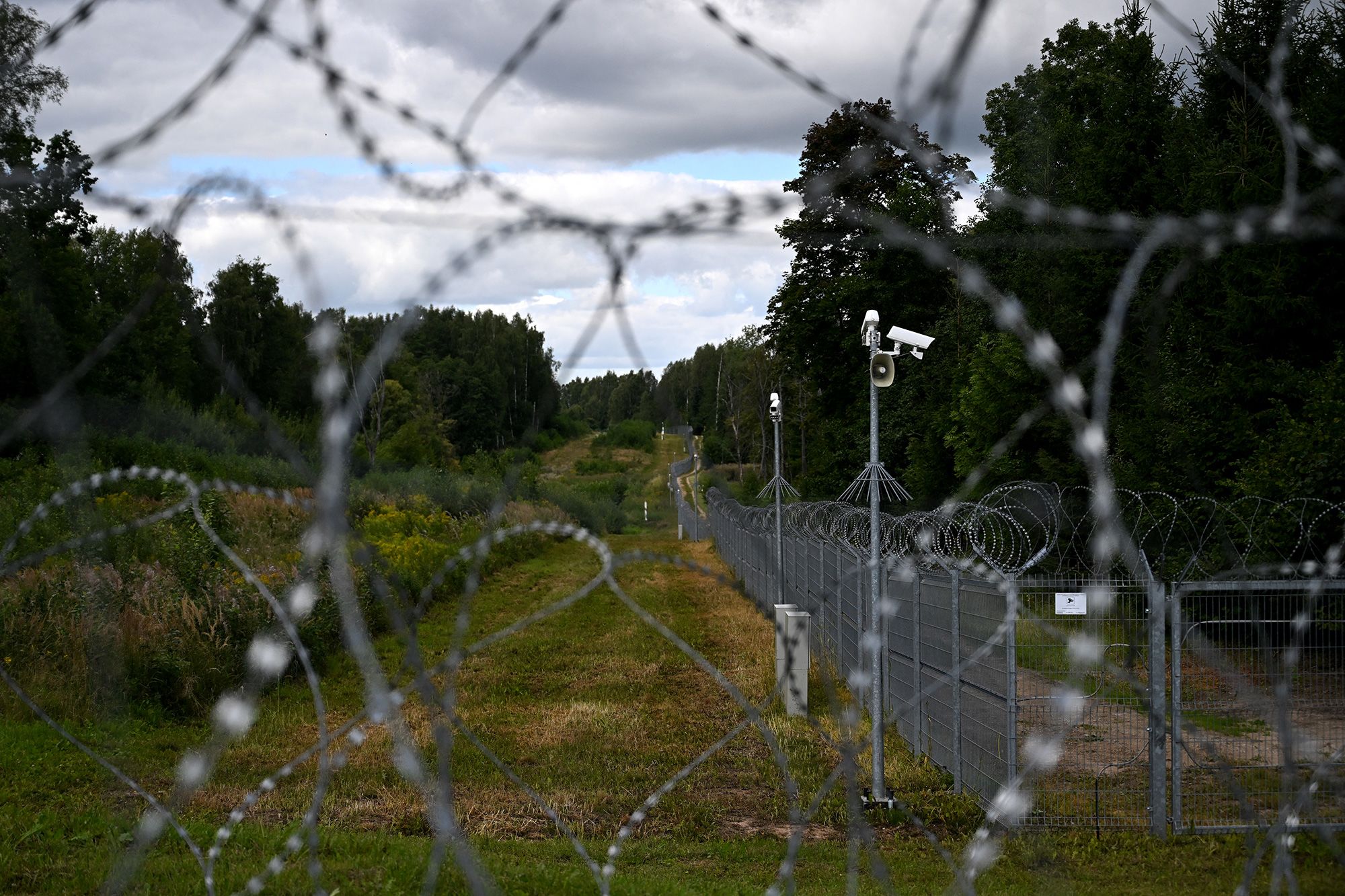
In response to the Russian invasion of Ukraine, EU countries bordering Russia and Belarus have erected border fences and fortifications, while the Baltic states have begun planning a “Baltic Defense Line,” complete with bunkers and anti-tank ditches — and using natural defenses like bogs and rivers. Many Baltic experts also call for peatland restoration to be added.
Renaturalization doesn’t only offer a defensive advantage; restored wetlands can revive biodiversity, provide homes for endangered animals, absorb floodwaters and capture CO2. Drained bogs, on the other hand, release carbon, contributing to global warming.
“Biodiversity enables nature to ‘produce’ more adaptations to changing conditions,” says Katrin Evers, BUND’s project manager for biodiversity. “Intact forests or moors retain water in the area, and can thus protect against flooding on the one hand and drought on the other. They also filter the water and provide shade — in other words, they ensure a certain degree of climate resilience.”
Back on the Cheiner heath, a boarded-up GDR watchtower covered in graffiti still stands amidst the orchids — a reminder that the Green Belt remains a living memorial to the painful division and peaceful reunification of Germany. The Grünes Band is a landscape of remembrance as well as an extraordinary network of ecosystems. It’s an environment that directly connects nature and history — and where a border built for fear may yet offer a blueprint for resilience.
The-CNN-Wire
™ & © 2025 Cable News Network, Inc., a Warner Bros. Discovery Company. All rights reserved.
